

Guide
Jumping on a Trampoline: Safe Technique for Toddlers
Nov
Jumping on a Trampoline: Safe Technique for Toddlers
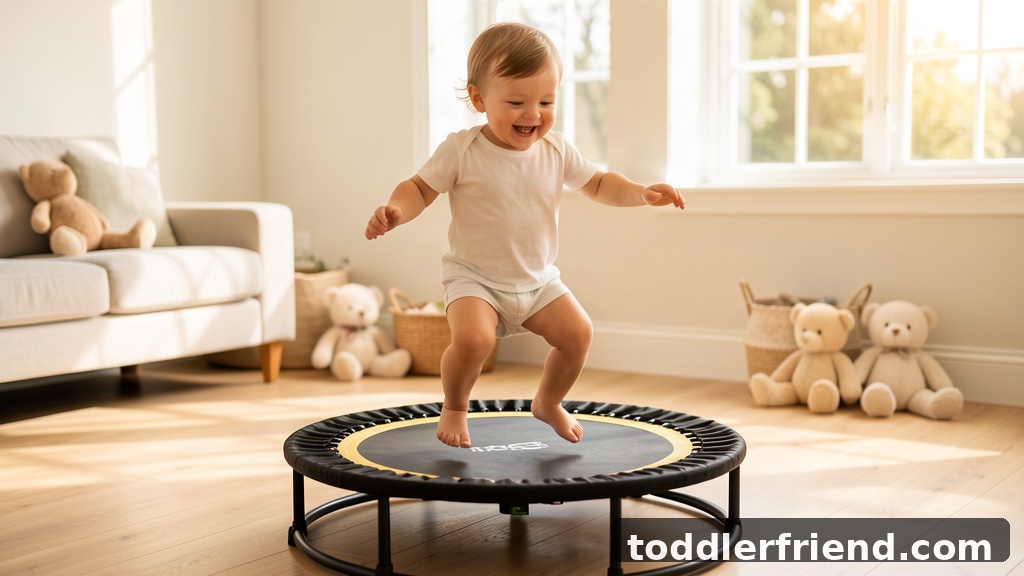
Jumping on a trampoline is a rebounding skill, not just a game: a child pushes off a tensioned mat, absorbs the landing through bent knees and hips, and lets the mat return the energy. For a toddler, safe jumping means low, controlled bounces near the center, one child on the mat at a time, inside an enclosure whose padding and net are intact.
Most parents do not set out to teach technique. They buy a small trampoline, unzip the net, and let a two-year-old find out what happens. That usually works for a week. Then the bouncing gets higher, a cousin climbs in, and the landing gets sloppy. The fix is not a stricter lecture from the doorway. It is a short set of habits a toddler can actually learn, taught on a trampoline sized for the body doing the jumping.
This guide covers what jumping demands from a toddler’s legs and balance, the rules that prevent most injuries, how to measure your space before buying, and how to teach the first controlled bounces. Every number here comes from published standards, manufacturer specifications or our own product pages.
What jumping on a trampoline asks of a toddler body
A bounce is a controlled fall followed by a controlled push. The mat drops under the child’s weight, the ankles and knees compress, and the return of the mat throws the body upward. Adults manage that cycle with mature ankle control and fast reactions. Toddlers are still building both, which is why they tend to land flat-footed and stiff-legged, and why a high bounce frightens more toddlers than it delights.
The motor skills involved are balance, proprioception (knowing where the body is in space) and the ability to absorb force with bent joints. A trampoline trains all three, which is exactly why pediatric therapists use small rebounders. The catch is that the same surface rewards a child who can already control a landing and punishes one who cannot yet.
Size is the practical answer. A full backyard trampoline is built for school-age children: our 7 ft hexagon outdoor trampoline and 8 ft round trampoline with safety net both list an age group of 3 years and up, with enclosure poles, springs and frame padding arranged for a child who can already land. A toddler’s first trampoline is a different object. The 55 inch enclosed toddler trampoline is a mini enclosed unit with a mat sized to a toddler’s stance, and it is the format we recommend first.
The rules that prevent most trampoline injuries
Safety guidance from orthopedic surgeons and pediatric clinics converges on a short list. None of it is exotic, and all of it fails when an adult is not watching.
- One jumper at a time. Two children on one mat collide, and the lighter child gets thrown by the heavier one. This single rule removes the most common serious-injury mechanism.
- Stay near the center. The middle of the mat is the most predictable surface. The edge is where feet slide between the mat and the springs.
- Keep bounces low and controlled. A toddler does not need height. Counting jumps out loud gives a child a target that is about rhythm rather than altitude.
- No flips, somersaults or tricks. Safety guidance from orthopedic surgeons advises against somersaults and flips on home trampolines, because landing on the head or neck is the injury pattern that turns a playground toy into a hospital visit. Keep those tricks off a toddler’s trampoline entirely.
- Bare feet, not sneakers. Bare feet grip the mat and let a child feel the surface. Socks slide, and ordinary shoes catch on the mat edge.
- Skip a wet mat. Water makes the jumping surface slippery and the frame slick. Wait until it dries.
The enclosure net is a fall barrier, not a license. A net prevents a child from being thrown off the trampoline; it does not stop a bad landing on the mat, a collision between two children, or a foot caught at the frame. Treat the net as the last layer, not the first.
Measure the space before the first bounce
Clearance matters more than most buyers expect. Manufacturer guidance for outdoor trampolines recommends roughly three feet of clear space on every side, measured from the frame rather than the mat, so a child who leaves the mat lands on grass instead of a fence, a shed or a patio step. Indoors, that same three feet has to come out of a room’s usable floor, which is why enclosed mini trampolines are the practical choice for apartments.
Published standards set the floor for what counts as a consumer trampoline at all. ASTM F381 covers consumer trampolines with a bed of at least 21,300 square centimeters and a height of at least 51 centimeters, intended for continuous vertical jumping, and it includes static load tests for the bed and frame plus padding tests. That is a scope definition, not a safety guarantee: a trampoline can meet the standard and still be the wrong size for a two year old.
| Item | Published figure | What it means for a toddler |
|---|---|---|
| Clear space around an outdoor trampoline | About 3 ft (0.9 m) on every side | Measure from the frame; a fence or patio inside that ring is a landing hazard |
| ASTM F381 minimum bed area | 21,300 cm2 | Below this, the product is not a consumer trampoline under the standard |
| ASTM F381 minimum height | 51 cm | Low frames are easier for a toddler to climb onto and off |
| Our 55 inch toddler trampoline | 4.5 ft diameter, 110 lb limit | Indoor or outdoor; short mat keeps bounce height predictable |
| Our 7 ft hexagon trampoline | Age 3+, 36 springs, 6 safety poles, outer enclosure | First backyard size for a child who can already land with bent knees |
| Our 8 ft round trampoline | 96 in diameter, mat height 21.6 in, 220 lb capacity | Room for one school-age child; still one jumper at a time |
| Springfree Jumbo Square (published spec) | 13 ft x 13 ft mat, 155 ft2 jumping area, 220 lb single-jumper limit | Example of how far an adult or family trampoline sits above toddler scale |
| SereneLife backyard model (published spec) | 96 in x 96 in x 94.1 in assembled, 80 in mat, 264 lb maximum | Maximum user weight is not the same figure as tested static load |
Teaching the first bounces in five steps
A toddler learns a bounce the way they learn stairs: in stages, with a hand available and no pressure to go faster. Work through these in order, and stop the session when attention goes, because a tired child lands worse than a fresh one.
- Let them sit and feel the mat. A seated child who shifts weight learns that the surface gives. No jumping, no net climbing, just cause and effect.
- Hold one hand and bounce together. Small bounces, both feet, adult counting out loud. The hand is for balance, not lift.
- Practice the landing on the ground first. Jump off a low step, land with knees bent and arms forward. Repeat until the landing looks soft without a reminder.
- Add two-foot jumps on the mat with a hand still there. Aim for ten small, even bounces. Even matters more than high.
- Step back and watch, then step in quickly. Stay within arm’s reach of the enclosure door. Praise the quiet landing, not the big jump.
Trampoline games are a good way to keep the bouncing low. Ball games give a child something to do with their hands and eyes while the legs keep a steady rhythm, which is why we pair our 5.5 ft mini toddler trampoline with enclosure with a soft ball rather than a height challenge. If you want structured ideas, our guide to ball and trampoline games for toddlers keeps every activity on the mat and none of them in the air.
The two-minute inspection before every session
Most trampoline failures are visible before they are painful. Run this check while the child is still putting shoes away, and stop the session if any line fails.
- Padding in place. Frame pads should cover the springs completely and sit flat, with no gap at the poles. ASTM F381 includes padding attachment and retention tests for this reason: a pad that slides off exposes steel.
- Net and zipper sound. Look for tears at the pole sleeves and a zipper that closes fully. An open door is the same as no enclosure.
- Mat stitching and spring condition. Worn stitching, stretched springs and rust at the hooks all change how the mat behaves. Outdoor models should specify UV-resistant mat and net materials.
- Frame and legs stable. Rock the frame gently. A wobble means loose joints or a leg sitting on soft ground.
- Surface dry. Dew counts. Wipe or wait.
What the standards actually cover
Three documents come up repeatedly when you read trampoline labels, and they cover different things. ASTM F381-24 is the consumer trampoline specification: components, assembly, use, labeling, UV-resistant material testing, static load tests for bed and frame, and padding performance. ASTM F2225 covers enclosures as a separate product, including UV resistance for exposed barrier materials and impact testing. EN 13219 is a gymnastic trampoline standard written for qualified supervision and expressly does not cover home-use trampolines, so a label citing it tells you little about a backyard model.
What none of them do is size a trampoline for a toddler. A manufacturer’s stated maximum user weight is the operating limit for the assembled unit, and a replacement mat’s advertised capacity is not. When a listing quotes a static load figure, treat it as a structural test number, not as permission to put two children on the mat.
Mistakes that turn a good bounce into a bad afternoon
The recurring problems are behavioral, which is why they repeat across brands and price points. Multiple jumpers, off-center bouncing, unearned tricks, a net treated as a babysitter, worn padding, and jumping in the wrong footwear or on a wet mat account for most of what goes wrong. Every one of them is a supervision decision rather than a product defect.
If you are still choosing between a mini indoor unit and a backyard trampoline, our comparison of outdoor toddler trampolines walks through enclosure styles and footprint, and the broader outdoor play equipment category covers swings, slides and climbers that pair well with a trampoline in a small yard.
Frequently asked questions
At what age can a toddler start jumping on a trampoline?
Most toddlers are ready for small, supervised bounces on a low enclosed mini trampoline between two and three years old, once they can jump with both feet off the ground and land without falling. Full-size backyard models in our catalogue list age 3 and up, and that figure assumes a child who can already control a landing.
How high should a toddler jump on a trampoline?
Low enough that the child stays in control and lands with bent knees. Ten even bounces a few inches off the mat is a better session than three high ones. Height is not the goal, rhythm and a soft landing are, and the enclosure net should never be used to gain extra bounce.
Do trampoline nets really prevent injuries?
An enclosure prevents falls off the trampoline, which is a real benefit, but it does not prevent collisions between two jumpers, bad landings on the mat or feet caught at the frame. Treat the net as one layer of protection and keep the one-jumper rule and adult supervision in place regardless.
Should toddlers jump barefoot or in shoes?
Bare feet are the usual recommendation because they grip the mat and let a child feel the surface. Socks slide and everyday sneakers can catch on the mat edge. Skip the session entirely if the mat is wet from rain or dew, since a slippery surface is the bigger risk either way.
How much space does a toddler trampoline need?
Allow about three feet of clear space on every side, measured from the frame rather than the mat, so a child who leaves the mat lands on a safe surface. Indoor models still need that clearance from furniture and walls, plus enough ceiling height for a small bounce and an adult standing alongside.
The bottom line
Jumping on a trampoline is a skill worth teaching rather than a toy worth handing over. Start on a unit sized for a toddler, keep one child on the mat, insist on centered and controlled bounces, and check the padding and net before every session. Those four habits cover most of what goes wrong, and they cost nothing.
If you are buying the first one, our mini toddler trampoline selection lists the low, enclosed models that fit a toddler’s bounce height, and the SZBOB 55 inch toddler trampoline is a widely reviewed example of the same format with a no-gap mat and a 220 lb stated capacity. Whichever you choose, read the manufacturer’s maximum user weight for the assembled unit and follow it.
