

Guide
Games With a Ball and Trampoline for Toddlers
Nov
Games With a Ball and Trampoline for Toddlers
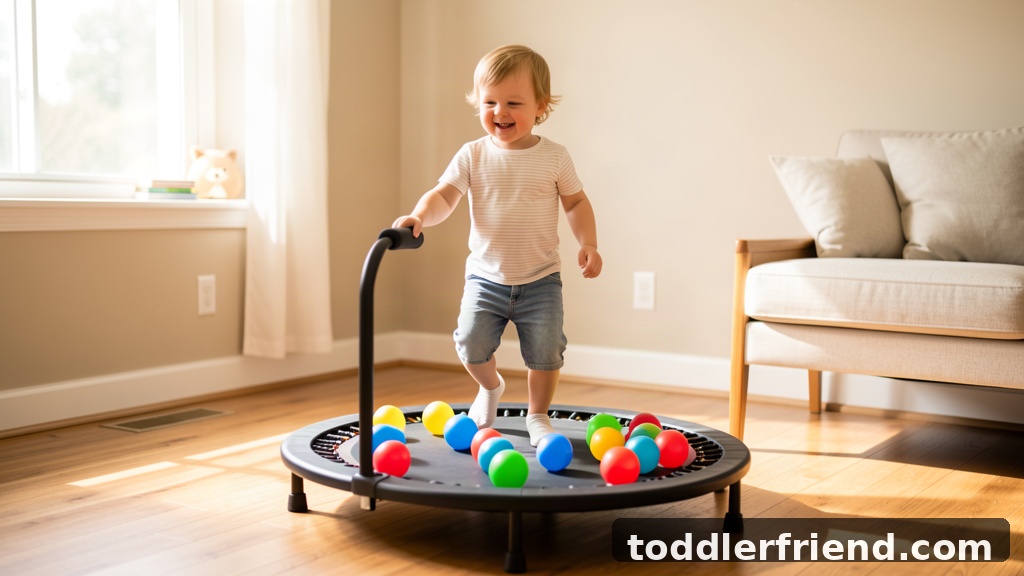
Definition: A ball-and-trampoline game is any bouncing activity played inside a small enclosed toddler trampoline using soft plastic pit balls. The balls add a target to chase and a task to finish, so a toddler stays on the mat longer while working on balance, tracking and hand control.
If you searched for a game with a ball and trampoline that a two-year-old can actually play, most results are product pages rather than instructions. That is because the phrase names a specific piece of kit: a 55 inch enclosed mini trampoline sold with a bag of soft plastic balls, with the mat doubling as a shallow ball pit. This guide covers what those sets really are, five games that fit inside the enclosure, the sizes and weight limits printed on the actual listings, and the one federal rule that decides whether the balls in the box are safe for your child.
The rule that applies to the balls, not the frame
Every set in this guide ships with loose plastic balls, and that is where the legal duty sits. Under 16 CFR Part 1501, an article intended for a child under three that presents a choking hazard from a small part is a banned hazardous substance. The small-ball rule in 16 CFR 1500.18 is stricter still: a ball one and three-quarter inches or less in diameter is banned outright for that age group.
Painted frames and coloured coatings are covered separately by 16 CFR Part 1303, which caps lead in paint and surface coatings on children’s products. Ask the seller for the compliance statement instead of judging a colour swatch photo.
What a ball-and-trampoline set actually is
These are not scaled-down backyard trampolines. They are 55 inch round frames, roughly waist-high, with a mesh enclosure, foam-sleeved poles and a jumping mat close to the floor. Several models ship with a hundred or so ocean balls, which turn the mat into a shallow pit when your child is not bouncing.
The single most useful thing to understand before you buy is that the size on the box is not the space your child gets. Of the five products in the table below, only one publishes a jumping-surface measurement alongside its outside diameter. Plan the games around the mat, not around the frame.
| Product | Outside diameter | Overall height | Jumping surface | Stated user weight limit |
|---|---|---|---|---|
| 55 inch enclosed toddler trampoline (Target listing) | 55 in (139.7 cm) | 43 in (109.2 cm) | Not stated | 100 lb (45.4 kg) |
| APRILSOUL 55 inch with ball pit | 55 in (139.7 cm) | 47.25 in (120.0 cm) | Mat 11.75 in off the floor | 110 lb (49.9 kg) |
| ModernLuxe 55 inch with enclosure and balls | 55 in (139.7 cm) | 42 in (106.7 cm) | 43.08 in (109.4 cm) diameter | 220 lb (99.8 kg) |
| KTMBDW 55 inch with enclosure and balls | 55 in (139.7 cm) | 43 in (109.2 cm) | Not stated | 400 lb (181.4 kg); a sister listing states 440 lb |
| SmarTrike 3-in-1 mini trampoline and ball pit | Not stated | Not stated | Not stated | 25 kg (55 lb); 100 balls included |
A 400 pound limit on a frame your toddler can step into is not a durability claim you should read as quality. It is a static load figure. The number that matters for a two-year-old is whether the enclosure is tall enough that they cannot climb out between bounces, and whether the spring cover sits flush against the mat so no gap opens at the edge.
Why the weight limits on these sets vary by a factor of four
The spread in the table is not a difference in build quality so much as a difference in how each brand defines the limit. Some quote a single-user recreational load, one quotes a test load, and the SmarTrike figure is for an activity centre with a detachable handlebar rather than a pure trampoline. Compare the limit to your child’s weight, not to your own.
Five ball games that fit inside the enclosure
A 55 inch mat is a small room. Games that need running, throwing hard or two children at once do not work here, and the manufacturer instructions on the enclosed models generally ask for one child at a time. These five use the space you have.
1. Ball sweep
Scatter the balls across the mat and ask your toddler to push them all to one side using only their feet. It is a balance drill disguised as tidying: they have to shift weight, look down, and stay upright on a moving surface. Two minutes is plenty for a two-year-old.
2. Drop and catch
Your child holds a ball at chest height, drops it onto the mat and tries to catch it on the first bounce. This is the game that teaches tracking speed. Start with the largest ball in the set so the bounce is slow and predictable, and move to smaller balls only after they are catching most attempts.
3. Colour sort
Put two empty tubs on the floor outside the net and call a colour. Your toddler collects that colour from the mat, steps out through the zip door, and drops it in the tub. It turns the enclosure into a sorting station and gives you a reason to open and close the door deliberately instead of climbing over the top.
4. Freeze bounce
They bounce while you count, and stop dead when you say freeze. The stopping is the hard part, and it is the same skill that keeps them from bouncing into the netting at speed. Keep counts short, three to five bounces, so the game ends on a success.
5. Roll and chase
Roll a ball along the mat so it circles the inside of the enclosure and let your toddler chase it without leaving the net. Because the enclosure is round, the ball keeps coming back, which is why this works in a space this small when a game of catch does not.
One warning from the product manuals: on sets that include a basketball hoop, swing or hanging rings, the instructions say to remove those accessories before using the trampoline function. The accessories are for floor play beside the unit, not for bouncing with.
The ball count is the most common complaint
If you want the pit to look like the product photos, the bag in the box will disappoint you. Owners of the SmarTrike 3-in-1 report that the 100 included balls barely cover the bottom of the pit, and one reviewer recommends buying about 250 more to fill it properly. Treat the included balls as a starter set and budget for a top-up bag.
Buy the refill balls by diameter, not by colour. Crush-proof pit balls are commonly sold at just over two inches, which clears the one and three-quarter inch small-ball threshold with room to spare. Anything smaller than a golf ball has no place in a set used by a child under three, whatever the listing says.
For a sense of how ball quantity changes the play value, our bounce house ball pit guide covers the same arithmetic for inflatable pits, where the fill volume is larger and the ball count matters even more.
Supervision, handlebars and the age floor
These sets sit in an awkward regulatory gap that is worth understanding before you trust an age label. ASTM F381, the standard for consumer trampolines, covers single-user home trampolines with a bed of at least 21,300 square centimetres and a height of at least 51 centimetres, and it states that compliant units are not recommended for children under six. A 55 inch enclosed toddler model does not match that description, and EN 71-14, the European toy trampoline standard, explicitly excludes units sold with extra features such as tents or basketball hoops.
Separately, under 16 CFR 1250 a toy sold in the United States must meet ASTM F963-23, the general toy safety baseline. That is the rule behind the ball and coating citations in the box above.
What that means in practice: the standard does not clear your toddler to bounce, and it does not ban them either. The manual is the document that sets the age floor for your specific unit, and the two things that make it work for a young child are the handlebar and your hand within reach.
Owners describe this in plain terms. One reviewer with a 13-month-old wished the trampoline had a guard around it, because a child that age can walk off the mat; the detachable handlebar is the feature designed for exactly that stage, and the listing says to remove it once the child is steadier. Our own 55 inch trampoline for toddlers is rated to a 100 to 110 pound limit, and the buyer feedback on that page makes the same point: it is a toddler and preschool unit, not a family trampoline.

How to choose one
Work through these four checks in order. They rule out most of the bad options before price enters the conversation.
- Measure the room, not the product. A 55 inch frame needs 55 inches of clear floor plus a margin for the zip door to open. Allow about five feet of clearance on the door side.
- Check that the spring cover meets the mat. A visible gap at the edge is where feet and fingers go. Seamed or stitched covers are the ones to look for.
- Confirm the ball diameter in writing. Ask the seller or read the refill listing. Two inches and up is the safe zone for a child under three.
- Match the weight limit to your child, with headroom. A 100 pound limit covers a toddler for years; a 220 pound limit is a different product aimed at older siblings.
If you already know you want an enclosed unit and want to compare shapes rather than sizes, our round-up of toddler trampolines covers the handlebar models that skip the enclosure entirely, and the outdoor toddler trampolines guide covers the larger framed versions for a yard.
For the two most common configurations: the 55 inch toddlers trampoline is the enclosed ball-pit shape described above, while the 5.5 ft trampoline for a toddler steps up to a 220 pound limit and a taller enclosure, which suits a four-year-old who has outgrown the handlebar stage.


Two models worth looking at
If you want a unit that arrives with the balls included, the Evedy 55 inch toddler trampoline with safety enclosure and balls is the configuration this guide describes: mesh enclosure, foam-padded poles, ocean balls in the box, and a stated 220 pound capacity.
If your child is heavier than a toddler rating allows, the BIGOU 55 inch indoor trampoline for kids publishes a mat diameter and a 220 pound limit rather than an outside-frame number, which makes it easier to judge how much jumping room you are actually buying.
Frequently asked questions
Can a two-year-old use a ball and trampoline set?
With supervision and a handlebar, yes, on a mini unit rated for their weight. The frame is not the limiting factor at that age; the loose balls are. Check the ball diameter against the small-parts rule first, then keep one adult within arm’s reach and let one child bounce at a time.
How many balls do I need to fill a 55 inch trampoline?
More than the box gives you. Owners of one 100-ball set report the balls barely cover the bottom of the mat, and suggest roughly 250 extra for a filled pit. A 55 inch mat covered to a shallow depth takes somewhere between 200 and 350 balls depending on diameter.
Is a 55 inch toddler trampoline the same as a 4.5 ft trampoline?
Yes, in most listings. Fifty-five inches is 4.58 feet, so retailers describe the same frame as 55 inch, 4.5 ft or 4.6 ft. Compare the jumping-surface measurement when two listings quote different foot sizes, because the outside diameter rarely changes.
Do trampoline balls need to be a certain size for toddlers?
They do. A ball one and three-quarter inches or less in diameter is banned for children under three under the small-ball rule, and the wider small-parts rule in 16 CFR 1501 catches any other piece of the set that fits the choke-test cylinder. Crush-proof pit balls sold at just over two inches are the size to buy, and smaller party balls should stay out of the box entirely.
Can two children play at once?
The enclosed toddler models are built for one. Manufacturer warnings on these units state that only one child should use the trampoline at a time, and the reason is structural rather than cautious: the mat is small enough that two children bouncing will collide and land on each other rather than the mat.
The bottom line
A ball-and-trampoline game works because the enclosure solves the two problems that stop toddlers bouncing: the fear of falling off, and the boredom of jumping with nothing to jump toward. Buy a unit with a seamed spring cover, a handlebar your child can grip, and a weight limit that leaves headroom, then spend the extra money on balls rather than on a bigger frame.
Corrections: if a specification in this guide does not match the manual that came with your unit, the manual wins. Tell us through the contact link in the site footer and we will update the table.
