

Guide
Ride On Toys for Two Year Olds: Fit, Wheels and Picks
Nov
Ride On Toys for Two Year Olds: Fit, Wheels and Picks
Definition: A ride-on toy for a two-year-old is a low, foot-powered seat on wheels, such as a push car, trike, wiggle car or balance bike, sized so the child’s feet reach the floor while seated and the frame stays flat when they climb on and off.
Most ride on toys for two year olds are sold on a promise the child cannot use yet. The box says ages two and up, the photo shows a grinning toddler mid-push, and what arrives is a seat too high for short legs or a pedal crank a two-year-old cannot turn while steering. The toy is rarely broken. The fit is wrong.
This guide sticks to what you can measure before you buy: seat height against your child’s inseam, seat width against their hips, the rider weight limit against their weight on a scale, the wheel count against how steadily they balance, and the standard the box claims against what that standard actually tests. No invented statistics, no rankings pulled from nowhere.
The three measurements that decide whether a ride-on fits
Overall length and height tell you whether the toy fits your hallway. They tell you almost nothing about whether your child can ride it. Three numbers do that work, and all three should be on the product page or in the manual.
- Seat height. Seated with the toy on level ground, your child’s feet should rest flat on the floor, or reach the pedals with knees slightly bent. CPSC activity guidance for this age makes the same point: a ride-on should be low enough to mount and dismount easily, with feet flat on the floor when seated.
- Seat width and depth. The seat is the only part of the toy that has to fit the child rather than the room. A seat under about 10 in wide pinches at the hips once a toddler is wearing a coat.
- Rated rider weight. This is a product-specific limit set by the manufacturer, not a property of the plastic. A two-year-old at 30 lb sits comfortably inside a 55 lb limit; a heavy three-year-old sharing the same toy with a sibling does not.
Here is what those numbers look like across the toddler ride-on classes we could find published specifications for. Overall size and seat size move independently, which is why the seat column is the one to read.
| Ride-on class | Overall (L x W x H) | Seat | Rated rider weight |
|---|---|---|---|
| Foot-to-floor car, 18-36 months | 63.5 x 28 x 36 cm | 28.5 x 20 cm, 22.4 cm off the floor | 25 kg |
| Foot-to-floor car, 12-36 months | 62.5 x 28.5 x 41.5 cm | 25 x 17 cm, 28 cm off the floor | 25 kg |
| Retro sit-to-stand car, 18-36 months | 23 x 11 x 13.5 in | 10.5 x 8 in, under-seat bin 8 x 3.5 x 5 in | 55 lb |
| Push-and-ride racer, ages 1-2 | 20.5 x 10 x 13.8 in | Not stated by the seller | 55 lb |
| 12V bumper car, ages 2-5 | 29.5 x 22.5 x 16.5 in | 12.5 in seat | 44 lb |
Across those toddler-sized models the rated limits run from 44 to 55 lb, roughly 20 to 25 kg. That range is what this sample shows, not a rule you can apply to a toy you have not read the label on.
Feet flat on the floor beats the age printed on the carton
A two-year-old who cannot plant both feet cannot stop, and a ride-on that will not stop is the one that goes down the driveway. Test the seat height in the shop, or measure the inseam at home against the published seat height before you order. If the seat is an inch too tall, no amount of practice fixes it this season.
The weight limit is a rating, not a material property
Two ride-ons moulded from the same high-density polyethylene can carry different limits, because the limit comes from the frame, the axle mounts and the test the maker ran. One HDPE toddler rocker we checked is rated for 55 lb at ages 18 to 36 months; that tells you about that toy, not about HDPE.
Foot-to-floor car, pedal trike, or balance bike?
Sort the choice by what your child can already do, not by what looks fun in the photo. The three families ask for different skills, and a two-year-old usually has one of them.
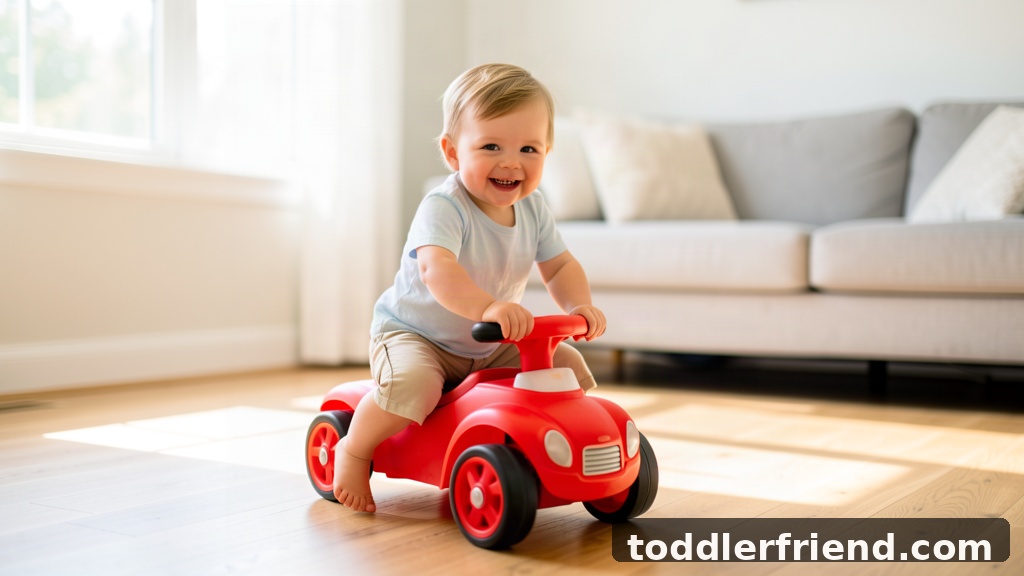
- Foot-to-floor push car. The child sits, pushes with both feet and steers with a wheel that often has a limited lock. It needs balance and nothing else. This is the default first ride-on for a child who walks steadily.
- Pedal trike. Needs pedalling and steering at the same time, plus enough leg length to complete a rotation. Reviewers who track this put coordinated pedalling closer to two and a half to three years, which matches the number of parents who report a trike that sat unused for a season.
- Balance bike. Needs the child to straddle the frame and walk it along. The seat has to drop low enough for both feet to reach the ground; the Strider 12 Sport, for example, lists a seat range of 11 to 17 in, and your child’s inseam has to sit inside that range with room to spare.
Quotable: the single most useful fit test is to sit the child on the toy with shoes on and check that both soles touch the floor. If they do not, the toy is one growth spurt early.
Wheel count and stance width decide how often it tips
CPSC guidance for this age group favours ride-ons with a low seat and wheels set relatively far apart, and notes that four-or-more-wheel designs tend to be more stable than two- or three-wheel designs. A wide track on four wheels resists the sideways shove a toddler delivers when they lean to see something.
That guidance is about static stability, not about speed. A three-wheel scooter can be perfectly stable standing still and still be the wrong toy for a two-year-old on a sloped driveway, because the child has to balance while it rolls.
Quotable: for a child who is still learning to steer, a low four-wheel ride-on with a wide track is the geometry that fails least often.
What the label promises, and what the toy standard actually tests
In the United States, ASTM F963 is the mandatory toy safety standard, incorporated through 16 CFR part 1250, and CPSC’s toy-safety guidance is explicit that it covers stability, overload and, where applicable, dynamic-strength requirements for ride-on toys. In plain terms: the toy should not collapse when a specified load is applied, and it should not tip under the test conditions the standard sets.
Three things follow from that, and none of them is a guarantee of service life.
- “ASTM F963” on a listing is a seller claim. It does not tell you which edition was tested or whether a report exists. The current edition is what the regulation points at, and CPSC publishes the reference.
- A passed overload test is not a durability promise. It means the toy did not collapse into a hazardous condition under the specified test loads. Cracks after a winter in the garage, UV chalk on a plastic shell and loose axle bolts are maintenance issues you own.
- The small-parts rule is separate. Under 16 CFR Part 1501, toys for children under three have to survive a choke-test cylinder. On a ride-on, the pieces that fail are the ones nobody thinks of: valve caps, bolt covers, sticker sheets, a horn button that pops off.
For the standards side, CPSC’s toy safety business guidance sets out how the requirements apply, and 16 CFR 1250.2 is the text that makes the standard mandatory.
Five fit problems that show up again and again
- Buying a size to grow into. A ride-on that is too tall now is hard to control and frustrating to ride. Buy for this season and expect to pass it to a younger child, rather than buying a larger one that sits in the garage.
- Starting on pedals. A trike bought for a second birthday often becomes a third-birthday toy. If your child cannot yet pedal and steer at once, a foot-to-floor car gets used now.
- Ignoring the seat width. A narrow seat is the complaint that arrives after the birthday, when the child rides for four minutes and climbs off.
- Choosing a tall, narrow design for looks. The styling that photographs well is often the shape that tips. Compare wheel spacing, not paintwork.
- Skipping the parental remote on anything powered. A 12V ride-on for ages two to five is a motor vehicle in miniature. Until the child steers reliably, the adult holds the remote, and a harness point is the feature that matters.
Two ride-ons worth a look for this age band
The Fisher-Price Harley-Davidson Tough Trike is the most direct pedal option here: it is sold for ages two to five with a stated maximum of 55 lb, a storage compartment under the seat and a wide three-wheel stance. For a child who can already pedal, that is the age band and the load rating in one place. Check the Fisher-Price Tough Trike listing on Amazon.
At the other end, a no-pedal balance bike suits the child who is still walking the toy along. The Kkdi balance bike is listed for 10 to 30 months with silent wheels and no pedals, which is the right shape for a two-year-old who is not ready to coordinate a crank. See the Kkdi balance bike listing on Amazon.
From our own shelves, the baby toddler balance bike and the KidRock balance bike S kit cover the walking-stage end, while the ride-on tractor with trailer is the foot-to-floor shape with a tow-along that keeps a two-year-old interested past week two. The full riding toys collection sorts by type if you want to compare seat heights side by side.
If the child is closer to three and asking for something with a motor, read our 6V versus 12V ride-on car guide before you buy, and if a scooter is on the list, the electric scooter age limits explain why most of them start older than two.
Frequently asked questions
What is the best ride-on toy for a two-year-old?
A low, four-wheel, foot-to-floor push car is the safest first choice for most two-year-olds, because it needs balance rather than pedalling or steering skill. Check that both feet reach the floor when seated and that the rated rider weight is above your child’s weight with room for a coat and boots.
Can a two-year-old ride a pedal trike?
Some can, most cannot yet. Pedalling and steering at the same time usually lands closer to two and a half to three years. If your child can complete a pedal rotation while looking ahead rather than at their feet, a trike with a 55 lb limit and an adjustable seat is a reasonable buy now.
How do I check seat height before ordering?
Measure your child’s inseam from the floor to the crotch while they stand in shoes, then compare it with the published seat height, not the overall height. Add an inch for winter clothing. If the seller does not publish a seat height, ask before you buy rather than guessing from a photo.
Is a 12V ride-on car suitable for a two-year-old?
Only with an adult holding the remote and the child strapped in. The powered cars we checked in this age band carry limits around 44 lb and a seat near 12.5 in, and they steer like a small vehicle rather than a toy. Treat it as a supervised ride, not something the child operates alone.
Do ride-on toys have to meet a safety standard?
Yes. In the US, ASTM F963 is mandatory under 16 CFR part 1250 and covers stability and overload testing for ride-on toys, and the small-parts rule in 16 CFR Part 1501 applies to toys for children under three. A compliant label is the floor, not proof that the toy suits your child’s size.
What to do before you buy
Measure the child first: inseam against seat height, weight against the rated limit, hip width against the seat. Then match the toy to the skill your child has today, not the one you hope for by summer. A foot-to-floor car that gets used every afternoon beats a trike that waits a year on a shelf, and the four-wheel, wide-track shape is the one that tips least while they learn.
Questions about a specific model, or a correction to something in this guide? Write to us through the contact link on the site and we will check it against the listing and update the page.
