

Guide
Sustainable Alternatives to Plastic Climbers for Toddlers
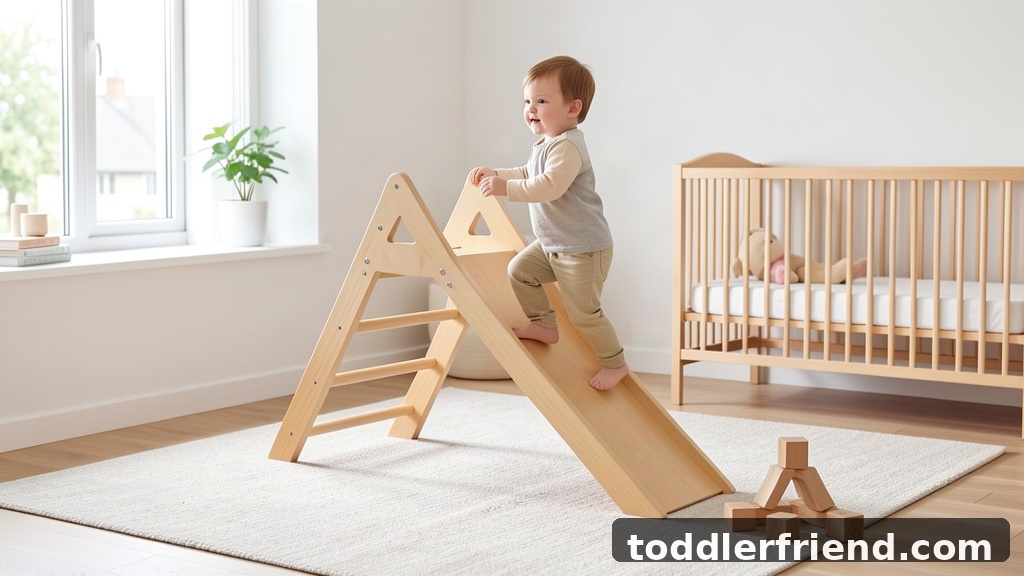
Oct
Sustainable Alternatives to Plastic Climbers for Toddlers
Sustainable alternatives to plastic climbers are climbing frames built from FSC-certified timber, bamboo, cork, recycled HDPE or recyclable thermoplastic instead of virgin plastic. They aim to cut fossil-fuel use and landfill waste, but the word sustainable says nothing about load limits, stability or toy-safety testing.
That gap is the whole problem with shopping this category. A listing can be genuinely lower-impact on materials and still ship a frame that wobbles on a floorboard, traps a foot between rungs, or carries no stated user weight at all. Parents searching for sustainable alternatives to traditional plastic climbers usually get one of two answers: a wooden Pikler triangle recommended on material grounds, or a recycled-plastic play structure with no numbers attached.
This guide separates the two questions. First, which materials actually reduce plastic and what each one demands in care and assembly. Second, the figures you need before checkout: footprints, folded storage depths, rated loads, and the certification lines that carry legal weight in the United States. Each figure below comes from the manufacturer’s or retailer’s own listing, gathered while researching this guide.
What “sustainable” covers in a toddler climber
Four material families show up in toddler climbing products, and each makes a different claim. They are not interchangeable, and a claim on one row tells you nothing about the rows below it.
- Solid timber (beech, birch, poplar, pine, cedar) is the classic Pikler-triangle material. Its environmental case rests on sourcing, which is what an FSC chain-of-custody certificate tracks.
- Composite wood (plywood, MDF, particleboard) is what most affordable folding triangles actually use, because it stays flat and takes a finish. It brings an adhesives question that solid wood does not.
- Recycled and recyclable plastic covers moulded play structures and, at the small end, climbing holds. Ghold, for example, says its recyclable thermoplastic holds can be recycled up to 10 times, and Binary describes vacuum-formed holds made with post-consumer recycled ABS.
- Bio-based composites (recycled bottles with hemp fibre, for instance) exist mostly in the climbing-hold market today, not yet in toddler frames in any volume.
One caution from the material research is worth quoting because it is the mistake this category invites: a hold or panel made from recycled material does not establish that the frame, joints or fasteners around it are safe for a child. The material is one input. The structure is the product.
Wood, recycled plastic and foam side by side
The practical comparison is not “which material is greener” in the abstract. It is which material survives a toddler, what it needs from you, and what happens at the end of its life. This table is the summary we would want before adding anything to a cart.
| Material | Typical toddler form | What the claim covers | What it does not cover | Realistic care |
|---|---|---|---|---|
| Solid timber (beech, birch, poplar) | Pikler triangle with ramp, folding climbing frame | Forest sourcing, if FSC chain-of-custody is documented | Load rating, stability testing, finish safety | Wipe clean, re-check screw torque monthly, sand and re-oil rough edges |
| Composite wood (plywood, MDF) | Cheaper folding triangles, arch and ramp sets | Nothing by itself; sourcing claim must be stated | Formaldehyde emissions unless the maker cites CARB Phase 2 or TSCA Title VI | Keep dry, never leave outdoors, inspect edge banding for lifting |
| Recycled or recyclable plastic | Moulded play structures, dome climbers, holds | Recycled content and recyclability, per maker claim | Structural safety, UV stability, fade over seasons | Hose down, check for stress cracks at joints each season |
| Soft foam and vinyl | Climb-and-crawl block sets | Padding and fall comfort | Any reduction in plastic use | Wipe with mild soap, keep out of sun, replace torn covers |
Foam deserves an honest placement. If the goal is less plastic rather than more padding, foam is the wrong column: a soft climbing block set is a padded vinyl-covered product, and its value is fall protection and portability, not material substitution. The direct trade-off between the two routes is set out in foam climbing blocks or wooden climbing toys.
The numbers that actually decide fit
Listed dimensions vary more than the product photos suggest. These six products were chosen because each publishes something measurable, which is itself the filter: a climber with no stated load rating cannot be compared to anything.
| Product | Material as listed | Footprint and storage | Rated load or capacity |
|---|---|---|---|
| Cliff folding climbing triangle | Wooden, folding, double-sided slide | Triangle 61 x 72 x 61 cm; slide 110 x 36 x 6 cm | 60 kg maximum load |
| Costway wooden climbing triangle set | Wooden, with slide | Unfolded 103 x 89 x 81 cm; folded 95 x 89 x 22 cm; slide 98 x 32 x 5 cm | 50 kg capacity |
| SUGIFT folding triangle climber | Beech rungs, poplar core frame, metal connectors | 48 x 28 x 43.5 in unfolded; folds flat to 7.5 in deep; ramp 47 x 14 in | 132 lb |
| KateHaa Pikler triangle | Wooden | Dimensions per model listing | 50 kg (110 lb) combined, one user |
| Skyward recycled-plastic playground | Recycled plastic, commercial | Use zone 41 x 30 ft | 30 to 40 children; 84 in fall height |
| Timberland recycled-plastic playground | Recycled plastic, commercial | Use zone 33 x 18 ft | 15 to 20 children; 72 in fall height |
Two patterns fall out of that table. The first is that comparable wooden triangles we found are rated at 50 kg, 60 kg and 132 lb, which is roughly the same figure expressed three ways, but none of it is a category standard you can assume. The second is that playground-scale recycled-plastic equipment is specified by use zone, not footprint. The Skyward structure wants a 41 x 30 ft area around it; the structure itself is smaller than the space it requires.
Quotable: listed load ratings on Pikler-style wooden climbers we checked run to 50 kg, 60 kg and 132 lb, so the model’s own manual, not the category, is the number to trust.
The certificate lines that carry legal weight
Four labels appear on toddler climber listings. Three of them mean something specific in the United States, and one is a sourcing certificate that is routinely over-read.
ASTM F963-23 is the consumer safety specification for toy safety and covers toys intended for children under 14 years. Its section 4.15 addresses stability and overload. What matters when you read a listing: a stated product weight rating is not evidence of F963 compliance, and whether the standard applies to a given frame depends on its classification, its intended age and how it is marketed.
CPSIA limits split into two figures that people merge by accident. Total lead may not exceed 100 ppm in an accessible component part, and lead in paint or other surface coating may not exceed 90 ppm. Regulated phthalates are capped at one-tenth of one percent, which is 1,000 ppm of each regulated phthalate in an accessible part. Those are per-component limits, not a whole-product average.
CARB Phase 2 and TSCA Title VI set formaldehyde emission limits for composite wood – hardwood plywood, MDF and particleboard – rather than for solid timber. The caps are 50 ppb for hardwood plywood, 110 ppb for MDF, 130 ppb for thin MDF and 90 ppb for particleboard, where one ppm is 1,000 ppb, so read the spec sheet rather than the word wooden. The EPA also treats many laminated products as hardwood plywood from March 22, 2024, subject to exemptions. The full rule is on the EPA formaldehyde standards page.
FSC chain of custody tracks certified forest material through ownership changes to the finished product. It carries no emissions limit and no chemical limit, and it certifies nothing about structural strength. If a listing says FSC wood, the useful follow-up is whether the finished frame is covered by the maker’s chain-of-custody certificate, not just the board that went into it. The programme’s own description is at FSC chain of custody.
Paint is the one place where the federal rule is old, specific and worth knowing by number. The 90 ppm coating limit sits in the regulation on lead-containing paint and coatings, 16 CFR Part 1303, and it applies to the finish on a wooden frame, not only to toys that arrive painted bright colours.
What owners report after a few months
Review research across indoor climbing sets surfaces a consistent set of complaints that have nothing to do with material and everything to do with construction. They are worth reading as a checklist rather than as product criticism.
- Assembly that runs long. One roundup reports parents spending as long as 2.5 hours on a set, with holes that do not line up and a second adult needed to hold pieces in place.
- Wobble on uneven floors. Reviewers describe frames that sit unevenly, and one listing summary mentions a middle section that does not lock securely.
- Splinters and rough edges, concentrated on ramp edges, plus gaps wide enough for a child’s foot between arch slats.
- Size surprise in both directions. Some sets are smaller than the age range implies, others take more floor space than the photo suggests.
- Outgrowing the triangle. Smaller triangles stop being interesting or safe-feeling well before the marketing age range ends.
None of those failures would be caught by a material claim. All of them would be caught by a ten-minute check on the floor of the room where the climber will live.
A five-step check before you buy
- Measure both states. Note the unfolded footprint and the folded storage depth. A set that folds to 7.5 in deep can live behind a door; one that folds to 22 cm still needs a wall.
- Find the rated load and the user count. A figure like 50 kg or 110 lb combined, one user at a time, is usable information. “Sturdy” is not.
- Read the joint and fastener spec. Metal connectors and pre-drilled, aligned holes are what stop the wobble complaints above. Check that any ramp or slide attaches firmly rather than resting on rungs.
- Check finish and openings. Smooth surfaces, sealed edges, and no gap that could take a foot, hand or head. If the finish is rough on arrival, stop and take it up with the maker before a child uses it.
- Plan the floor and the fall zone. Level surface, away from radiators and windows, and enough clearance that a fall lands on something other than tile. Our kids climbers playground setup and safety guide walks through the clearance maths for larger frames.
Where our own picks fit
We sell both routes, and the honest summary is that they answer different questions. If the goal is a lower-plastic indoor climber, the wooden and folding triangle route is the one to research against the load figures above. Two widely sold examples with published specs are the Goodevas Montessori climbing triangle set and the BlueWood 7-in-1 Pikler triangle set; check the weight rating on the exact model page, because the same brand name ships in several sizes.
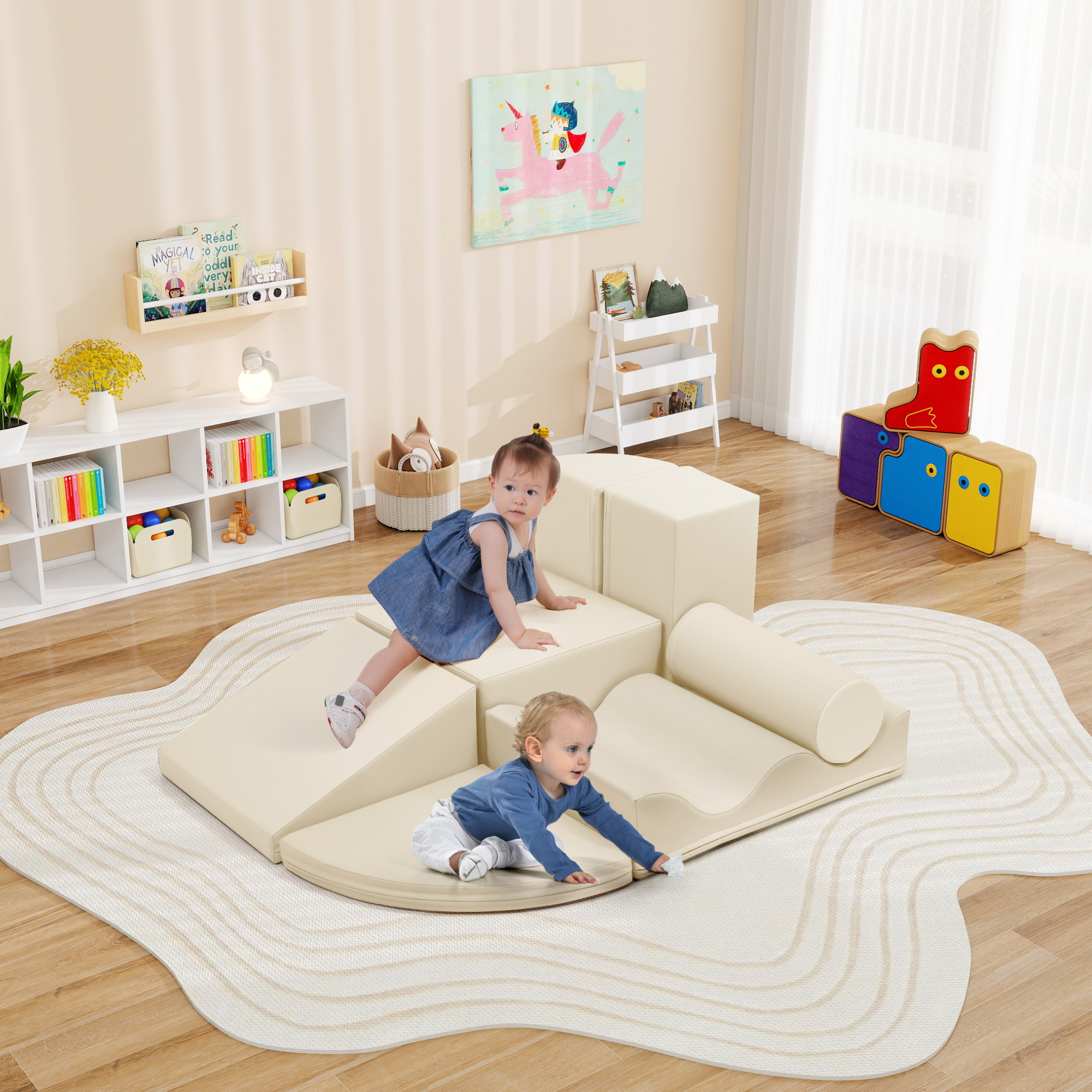
If the goal is padding, portability and a first climbing experience for a one-year-old, the soft route is better value. Our 7-piece indoor climbing foam set is the one we stock most often for that stage.
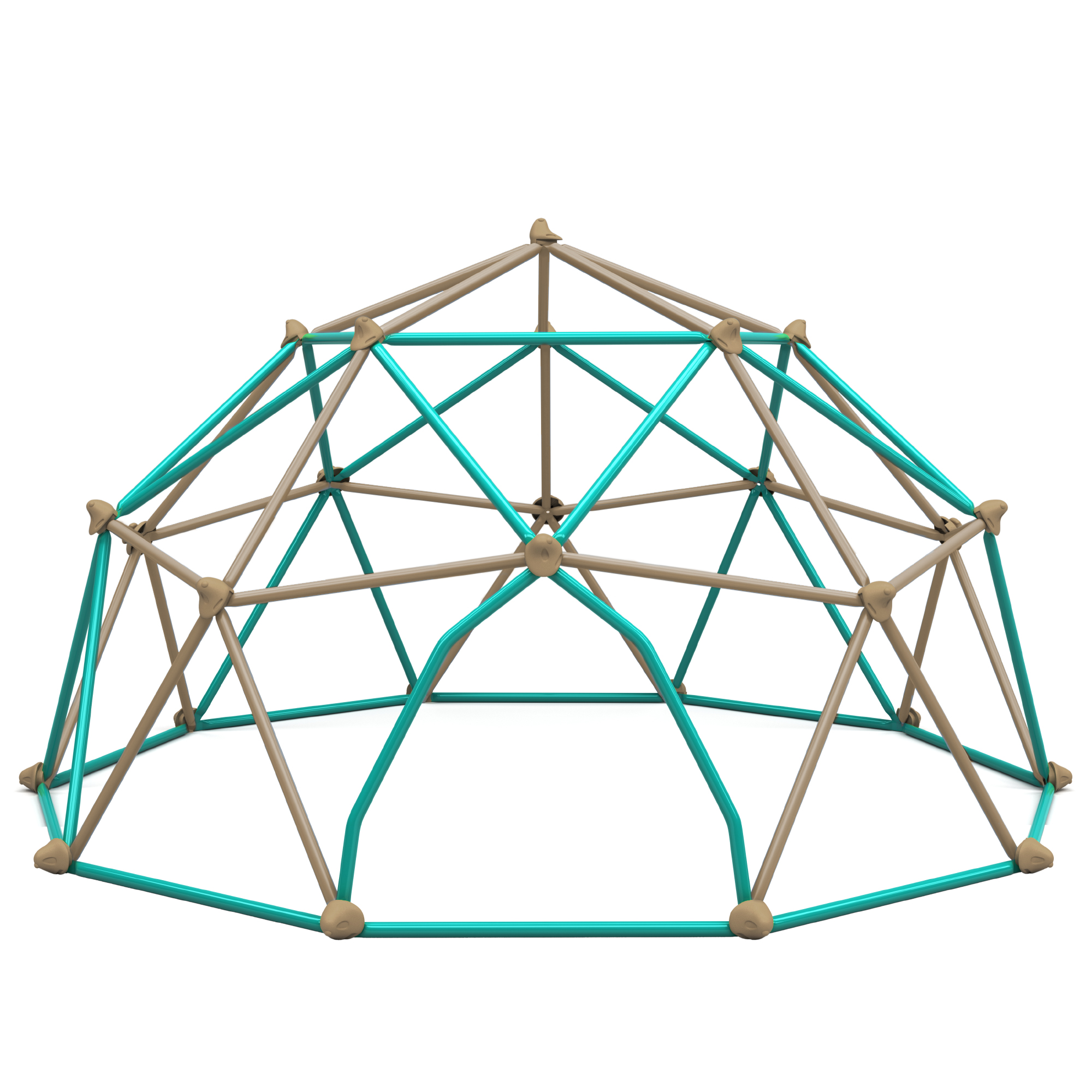
For a garden or a large playroom, the recycled-plastic and steel frame route is the durable answer and the closest thing to a genuinely long-life product in this category: a dome that gets inspected each season and re-anchored when needed outlives a ladder of short-lived toys. Our 12 ft geometric dome climber play center and the wider outdoor play equipment range are where that comparison starts, and the broader material trade-offs are covered in choosing safe and eco-friendly toys for toddlers.
Frequently asked questions
Are wooden climbing toys actually more sustainable than plastic ones?
Usually on material, not automatically on lifespan. Wood from a certified forest replaces fossil-fuel feedstock, but a plywood frame carries adhesives and a cheap wooden triangle that wobbles gets replaced in a year. A recycled-plastic structure that lasts a decade can beat a short-lived wooden one on total material use.
Is a Pikler triangle safe for a one-year-old?
It can be, if the model’s age guidance covers it and the ramp attaches firmly. Check the rated load, the gap widths between rungs, and the finish. One folding triangle we checked is marketed from six months to six years; that is a marketing range, not a guarantee, so for a one-year-old use the lowest rung, lock the ramp flat and stay within arm’s reach.
What weight limit should a toddler climber have?
There is no single industry figure. The wooden triangles we checked list 50 kg, 60 kg and 132 lb, and one maker states a 50 kg combined limit for a single user at a time. Treat the number on your specific model as the limit and stop using the frame if it exceeds it.
Does FSC certification mean the climber is safe?
No. FSC chain of custody tracks forest material through the supply chain and carries no emissions or chemical limit. It says nothing about structural strength, stability, load rating or finish safety. Toy safety in the US is a separate question, answered by CPSIA limits and ASTM F963 testing.
How much space does a foldable climbing triangle need?
Plan for the unfolded footprint plus clearance. One listed example measures 48 x 28 x 43.5 in unfolded and folds to 7.5 in deep for storage; another unfolds to 103 x 89 x 81 cm and folds to 95 x 89 x 22 cm. Measure the room in both states before ordering.
The bottom line
Sustainable alternatives to plastic climbers exist in every price band, and the material choice is the easy half of the decision. The half that decides whether the toy survives your toddler is the boring one: a stated load rating, fasteners that line up, a finish with no splinters, and a footprint that fits the room in both its open and folded states.
Start with the wood-versus-recycled-plastic question using the tables above, then verify the exact model’s load rating and age guidance before you order. If you are choosing between a hard frame and a padded one for a child under two, the foam route is the safer first step; the same load-and-clearance checks apply when they move outdoors onto a dome or a climbing frame.
