

Guide
Affordable Wooden Swing Sets: Real Prices and Wood Types
Oct
Affordable Wooden Swing Sets: Real Prices and Wood Types
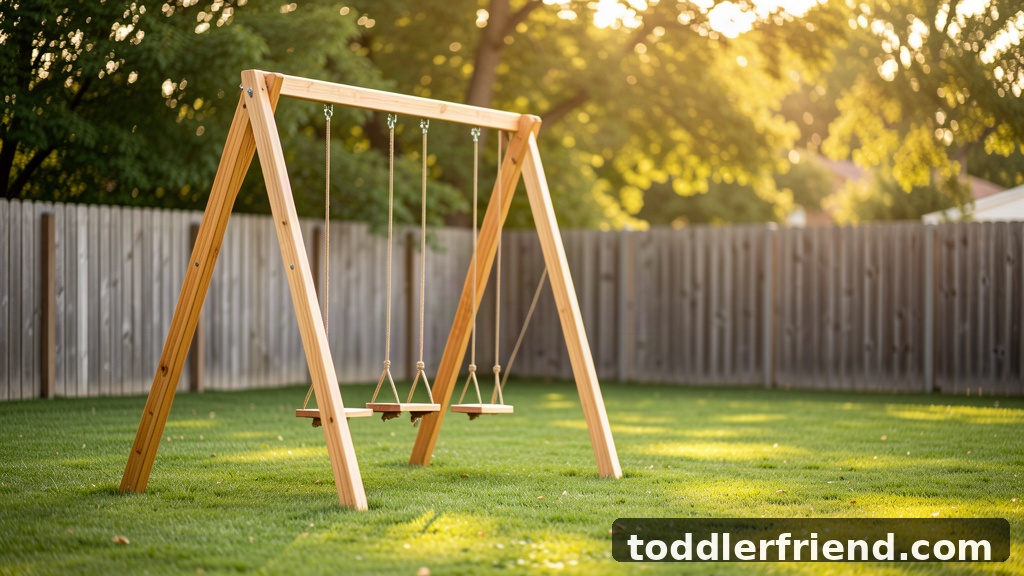
Affordable wooden swing sets are residential backyard swing sets framed in cedar, pressure-treated pine or spruce and sold as kits. In 2026 that word “affordable” means roughly $400 to $700 for a bare A-frame with two belt swings, before surfacing, anchors and assembly.
Most parents start shopping with one number in mind, then discover the kit price is not the project price. The lumber arrives in a flat pack, the hardware comes bagged, and the yard still has to be measured, levelled and surfaced. This guide works through what the listed prices actually buy, which wood species matter and which do not, the safety label worth checking, and the three measurements that decide whether a set fits before you ever add it to a cart.
What affordable wooden swing sets actually cost
Listed prices cluster into three bands, and the jump between them is driven by the tower, not by the wood. All figures below are listed retail prices from the retailers named, captured in October 2026, before tax, shipping and assembly.
| Configuration | Typical listed price | Example listing |
|---|---|---|
| Bare A-frame, two belt swings, no tower or slide | $399 to $700 | Backyard Discovery Durango, $399 at Wayfair (shown discounted from $429) and $429 at Walmart |
| Tower and swing combination, often with a slide | $999 to $1,799 | Atlantis, $999 at Walmart; Grayson Peak, $1,099 at Sam’s Club; Mystic Tower, $1,498 at Sam’s Club; Endeavor II, $1,799 at Walmart |
| Large or feature-heavy playset | $2,199 to $3,500 | Skyfort III, $2,199 at Sam’s Club; Woodridge Elite, $2,499 with listed options to $3,499; Skyfort II with spiral tube slide, from $2,399 at Backyard Discovery |
A reasonable shopping budget is therefore about $400 to $700 for a basic wooden A-frame, $1,000 to $1,800 for many tower and slide sets, and $2,200 to $3,500 for the larger playsets. Some simpler cedar playsets do list below $1,000, so “has a tower” alone does not define the price tier.
One thing the research does not support is a clean wood-versus-metal premium. A wood A-frame lists at $399 while a metal Lifetime A-frame playset lists at $2,199 at Sam’s Club, but those two listings are not the same configuration, so quoting a “wood costs X percent more” figure would be inventing a number. Match the feature list first, then compare.
Cedar, pressure-treated pine or spruce: what the wood tells you
Wood species is a decay question, not a strength rating. The frame’s load capacity comes from its design, lumber dimensions and hardware, and it is stated per model in the manual. With that caveat, here is what each species actually signals on a budget listing.
- Cedar is naturally resistant to decay, which is why Backyard Discovery describes its cedar Lakewood set that way. That is a real outdoor durability advantage, but it is not a load rating and it does not remove the need to inspect and maintain the set.
- Pressure-treated pine is treated to protect the wood against decay and insects. Actual service life depends on the lumber, the treatment, exposure, design, assembly and upkeep, so treat generic lifespan claims on a listing as marketing rather than data.
- Spruce appears on some budget listings with a weather-resistant coating. A coating, and a product description mentioning it, is not by itself evidence of any particular service life or load capacity.
What matters more than the species is whether the listing names its treatment, its hardware specification, its warranty and its per-model weight limits. A cedar set with vague limits is a worse buy than a pine set with explicit ones.
The safety label worth checking, and what it does not promise
The relevant voluntary standard for this category is ASTM F1148-22, Standard Consumer Safety Performance Specification for Home Playground Equipment. Its scope covers home playground equipment for children over 18 months through age 10, including swings. Read that scope carefully: it sets safety performance requirements, not a universal number of pounds that every set can carry. You can read the scope at the ASTM F1148-22 listing.
The Consumer Product Safety Commission identifies ASTM F1148 as the home playground equipment standard and discusses the hazards it addresses, including falls, impact, entrapment, and installation or maintenance problems. The CPSC also notes that there are no specific statutory requirements for outdoor-only home playground equipment, while other children’s product requirements may still apply. The commission’s guidance is at CPSC Playground Equipment. The American Academy of Pediatrics goes a step further and advises parents to choose home playground equipment labelled as meeting ASTM F1148.
Practically, that means a conformity claim is worth checking against the exact model in front of you. Backyard Discovery states that its Lakewood is 100% cedar, intended for residential use, and engineered to meet or exceed ASTM F1148-22. That claim is model-specific. Look for the equivalent sentence for whatever set you are considering, and check which edition of the standard it references.
Three measurements to take before you order
1. Per-swing limit, total limit and per-child limit are different numbers
Wooden sets sold as residential kits commonly list a per-seat limit of 100 to 115 lb, with a separate total capacity for the whole frame. The Gorilla Playsets easy-to-assemble wooden set, for example, lists 115 lb per swing and 345 lb total. A listing for Backyard Discovery’s Endeavor gives 150 lb maximum tested weight for a single-child item and 120 lb per child where the item is intended for more than one child. Never infer a safe load from wood species or from how solid the frame looks, and always follow the lowest limit that applies.
2. The footprint plus the safety zone, not the footprint alone
One manufacturer recommendation is to leave a 6 ft perimeter around the set. Applied to a 92 × 104 × 82 in set, that produces a recommended overall area of about 20 ft 8 in wide by 26 ft 8 in deep. Compact wooden A-frames run around 70 × 71 in, larger multi-station sets about 144 to 168 in long, and the Swing-N-Slide PB 8360 Ranger lists 8.7 × 7.7 × 6.8 ft with a 115 lb per-user limit. Mark the full area on the grass with string or paint before you buy, not the kit dimensions.
3. Ground and overhead clearance
Buying guides and owner reviews repeatedly flag sloped or hard ground and branches, eaves or power lines in the swing arc. Choose a clear, level location, look up before you dig, and plan for impact-absorbing surfacing rather than bare compacted soil.
How to cut the price without cutting the structure
The single biggest cost driver in the tier table is the tower. Moving from a bare A-frame to a tower and slide set takes the listed price from around $399 to $999 and up, and the frame lumber under the swings is broadly the same product. If the goal is swinging, climbing up and sliding down, an A-frame plus a small separate slide costs a fraction of a tower set, and it also fits a smaller yard.
- Buy the A-frame first. Two belt swings on a cedar frame is the configuration that lands in the $399 to $700 band. The Backyard Discovery Durango cedar swing set kit is that exact shape: classic A-frame, two belt swings, pinch-free ropes, lumber and hardware included.
- Add swing variety instead of a tower. A cedar set with two belt swings and a trapeze bar, like this cedar wooden swing set with belt swings and trapeze bar, gives two children different ride types for far less than a clubhouse.
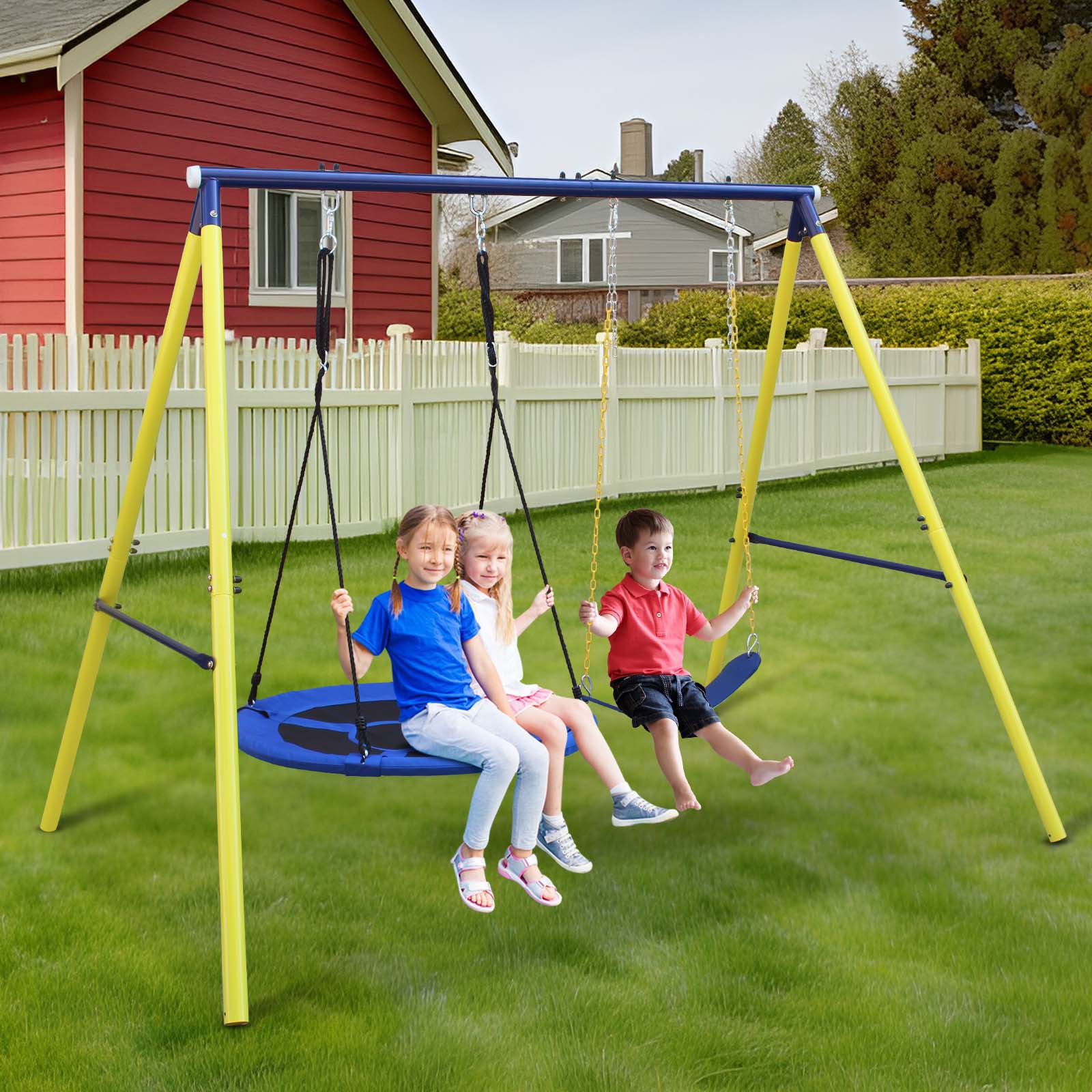
- Compare against steel honestly. If the budget is genuinely tight, a steel A-frame is the cheaper route to the same swinging motion. Our play swings collection currently lists steel sets from $117.09 (the Outdoor Metal Swing Set at $127.02, the 2 in 1 Swing Set at $132.49 and the 6 in 1 Swing Set at $185.19). Wood buys appearance and repairability; steel buys a lower entry price.
- Budget the build, not just the box. Owners report misaligned holes, damaged or ill-fitting pieces and builds that take far longer than expected. If a large kit is beyond a comfortable weekend, price a paid installer before you commit.
- Check the parts on delivery. Cracked or split boards are a recurring complaint, and cedar splits around screw holes when fasteners are overtightened. Open every carton while the return window is still open, and contact the seller about damaged pieces rather than forcing them into place.


What the cheapest wooden kits get wrong
Price alone does not predict a bad set, but the failure modes at the bottom of the market are consistent. Reviews describe wobbling frames and owners questioning whether a set could handle more than one small child, so check the intended ages and the capacity before you assume a second child can ride along. They describe split and cracked lumber, particularly when screws are driven too hard. And they describe hardware that arrives incomplete or does not line up.
The fix is procedural rather than expensive: read the manual’s assembly and anchoring requirements before buying, confirm the model’s own weight limits, and plan a hardware and bolt re-check at the start of each season. A $399 frame that is inspected and maintained outlives a neglected $2,000 one.
If you want the wider picture on how outdoor play equipment fits a toddler’s development before choosing a configuration, our guide to outdoor play equipment for toddlers covers the developmental side, and our swing set safety and buying guide goes deeper on installation and supervision.
Frequently asked questions
How much should I budget for an affordable wooden swing set?
Plan on $400 to $700 for a bare cedar A-frame with two belt swings, and $1,000 to $1,800 once a tower and slide are included. Add surfacing, anchors, and either your own weekend or a paid installer, since listed prices exclude all three.
Is cedar worth the premium over pressure-treated pine?
Cedar is naturally decay-resistant, which matters in wet climates, while treated pine relies on its treatment to resist decay and insects. Neither species sets the load rating. Compare the treatment details, hardware, warranty and stated weight limits rather than paying extra for a wood name alone.
How much space do I need around a wooden swing set?
Manufacturers commonly recommend about 6 ft of clearance around the set. A 92 × 104 in frame with that perimeter needs roughly a 20 ft 8 in by 26 ft 8 in area, so measure the usable yard and mark the full safety zone before ordering.
What weight limit should I look for?
Budget-friendly wooden kits usually list 100 to 115 lb per seat, plus a separate total for the frame. Follow the lowest applicable figure, keep per-seat and total limits separate, and do not treat a children’s set as adult-rated equipment.
Are cheap wooden swing sets safe?
Safety comes from the design, the stated limits and the installation, not the price tag. Choose a set whose listing names ASTM F1148-22 conformity, explicit weight limits and anchoring requirements, then install it on level ground with proper surfacing and inspect the hardware each season.
The bottom line
The affordable path to a wooden swing set is a bare A-frame in the $399 to $700 band from a brand that publishes its weight limits and its ASTM F1148-22 claim, measured against the full safety zone rather than the kit footprint. Spend the difference on surfacing, anchors and a proper install. If swing motion matters more than the look of timber, compare our outdoor play equipment collection before you decide which material earns the space in your yard.
