

Guide
Best Electric Bumper Cars for Toddlers: Safe Spin-Filled Fun for Ages 1-4
Aug
Best Electric Bumper Cars for Toddlers: Safe Spin-Filled Fun for Ages 1-4
An electric bumper car for toddlers is a low, round, battery-powered ride-on designed for children ages 1-4, usually running on a 6V or 12V battery at speeds between 1.5 and 3 mph. It spins 360 degrees, bumps into things safely thanks to a soft bumper ring, and most models come with a parental remote control for start-stop and steering override.
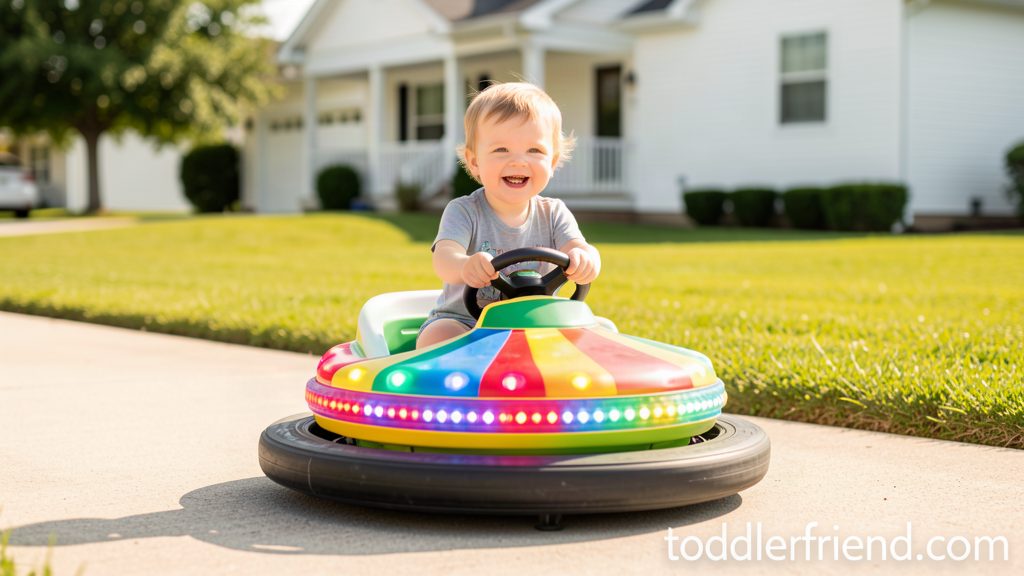
My son got his first electric bumper car the week he turned two, and I will be honest with you: I bought it for the novelty and stayed for the peace of mind. Watching him spin lazy circles on the patio, bouncing off a Rubbermaid bin like a tiny bumper boat, is somehow both the most ridiculous and most useful toy purchase we have made. If you are shopping for one, here is what I learned the expensive way, so you do not have to.
Why parents buy toddler electric bumper cars
The bumper car shape is not a gimmick. The round body and soft ring mean a toddler can bump into walls, furniture, and siblings without the sharp-cornered crash you get from a square ride-on jeep. The whole point of the design is that bumping is part of the fun, and that takes a lot of the stress out of supervised play.
There is a developmental angle too. Steering with a wheel, working a foot pedal, judging distance before a bump, these are real gross motor and spatial skills. A 2-year-old who can steer a bumper car around a room is practicing the same coordination that will later get them on a balance bike. And on days when the playground is out of reach, it is a dependable way to burn energy indoors.
Are electric bumper cars safe for toddlers?
Short answer: yes, when you pick the right model and stay close. Every bumper car we recommend meets ASTM F963, the mandatory U.S. toy safety standard, and reputable brands register with the CPSC so you get recall notices automatically. Look for that registration card or listing before you buy.
Two features do most of the safety work. First is the parental remote, usually 2.4 GHz, which lets you stop the car instantly from up to about 30 feet away. Some remotes only handle start-stop; better ones steer and brake too. Second is speed. Models sized for ages 1-3 top out around 1.5 to 2.5 mph, which is a brisk walk. A 12V two-speed model on the low setting is about 2-3 mph, and the high setting, up to 5 mph, belongs to kids closer to 4 with good control.
Ground rules that matter more than any feature: always supervise, keep the car on flat surfaces away from streets and driveways, make sure the seat belt or harness is buckled, and do not let two kids pile on unless the weight limit allows it. Weight limits on toddler bumper cars generally run 55 to 66 pounds, and exceeding them is the fastest way to burn out the motor.
What to look for in an electric bumper car
Voltage and speed
Six-volt cars run about 1.5 to 2 mph and suit kids 12 to 24 months. Twelve-volt cars run 2 to 5 mph, often with a high-low switch, and fit ages 2 to 4. A full charge gives roughly 1 to 2 hours of run time, and charging takes 8 to 12 hours, so plan to charge overnight. If your floors or patio have any slope, skip 6V and go 12V.
Parental remote control
I would not buy a toddler bumper car without one. The 2.4 GHz remote is your kill switch when a toddler heads for the stairs or the dog. Check the listing carefully: full steering override is worth more than a remote that only starts and stops the motor.
360-degree spin
This is the signature bumper car move. A car that spins in place lets a toddler turn around without backing up, which makes steering dramatically easier for little hands. If the listing does not mention 360-degree rotation, the car probably only turns in a wide arc, and your toddler will get frustrated fast.
Build quality and materials
Plastic should feel thick, not flimsy, and edges should be rounded. Look for non-toxic, BPA-free materials, a wide wheelbase that will not tip, and UL-listed batteries and chargers. A bumper car that rattles when you shake it will not survive a toddler, and a cheap charger is a fire risk you do not want plugged in overnight.
Features that matter, and the ones that do not
Working LED lights, a horn, and an AUX or USB music port are nice. A Bluetooth speaker that screams at full volume is not. My advice: pick the simplest model with the safety features above. Fewer electronics means fewer breakages and fewer fights over volume.
Electric bumper car by age: which one fits your toddler?
- 12 to 24 months: 6V, 1.5 to 2 mph, weight limit around 55 pounds, $70 to $130. These are gentle, low, and easy to steer with a remote.
- 2 to 3 years: 12V with parental remote, 2 to 3 mph on low, $130 to $220. This is the sweet spot for most families.
- 3 to 4 years: 12V two-speed, up to 5 mph on high, $180 to $300. Bigger seats, better suspension, and enough power for gentle slopes.
If your child sits between categories, size up. A tall 2-year-old in a 6V car will outgrow it in months, and you will be shopping again by summer.
Brands parents trust
Kidzone makes some of the most popular toddler bumper cars on the market, with remote control, LED lighting, and 360-degree spin in a compact package. Best Choice Products covers the budget range with surprisingly complete feature sets. Costzon and Uenjoy offer solid mid-range options, and Rollplay makes sleek, lightweight models that are easy for small kids to steer. Whatever brand you choose, read recent reviews for battery life complaints, the most common failure point on budget models.
For a detailed look at what the Kidzone 6V model offers, check current pricing on Amazon.
How to choose and set up a toddler electric bumper car
Follow these steps and you will be off to a good start:
- Match voltage to age and terrain. Under 2 years old or flat floors only, choose 6V. Over 2 years or any slope, choose 12V.
- Confirm the remote controls steering and braking, not just start-stop, and test it during the return window.
- Assemble carefully. Most bumper cars take 20 to 60 minutes to put together, and loose wheels come from rushed assembly, not bad design. Tighten everything twice.
- Charge fully before the first drive, usually 8 to 12 hours, then test on flat, open ground with the remote in your hand.
- Teach one rule first: stop when a grown-up says stop. Practice it until it sticks before letting your toddler drive freely.
Maintenance that keeps it running
Treat the battery like the heart of the car, because it is. Charge it after every use, avoid running it completely dead, and store the car indoors over winter. A battery that sits drained for months is a dead battery by spring. Wipe the body with a damp cloth, keep the wheels free of gravel, and check the charger connection for heat or sparks. Bumper cars are simple machines, and simple machines last when you do the basics.
Frequently asked questions
What age can a toddler start using an electric bumper car?
Most manufacturers recommend 12 months as the minimum. A 1-year-old does fine in a slow 6V car with a remote-controlled start. By 2, most kids can steer and manage the pedal with supervision. By 4, many are ready for a 12V car at higher speeds, assuming they follow the stop rule.
How fast do toddler electric bumper cars go?
Six-volt models run about 1.5 to 2 mph. Twelve-volt models range from 2 to 5 mph depending on the setting, with low around 2-3 mph for beginners and high around 4-5 mph for older toddlers. For ages 1-3, keep the speed below 3 mph.
Can electric bumper cars be used indoors?
Yes, and that is one of their advantages. The soft bumper ring protects walls and furniture, and the low speed suits living rooms and playrooms. Just clear fragile items and keep the ride on hard, flat floors rather than thick carpet, which can stall the motor.
How long does the battery last on a charge?
Expect 1 to 2 hours of drive time on a full charge, with real-world results closer to 60 to 90 minutes on carpet or slight slopes. Recharging takes 8 to 12 hours, so charge overnight between sessions.
The bottom line
An electric bumper car is one of those purchases that looks like a splurge and quietly becomes the most-used toy in the house. Buy for your child’s age, keep the speed low, and make sure the remote works before the box goes in the recycling. Our 12V model has survived two years of patio duty, and the only thing we replaced was a wheel cover. Get the battery care right and these little cars just keep going.
If you want to see the exact models we stock and recommend, browse our 12V ride-on bumper car and 12V dual-drive bumper car. For broader ride-on guidance, our complete guide to electric ride-on cars covers safety and features in depth, and the kids electric car safety guide is worth reading before any battery-powered purchase.


