

Guide
How to Measure Kids Feet and Wingspan at Home: Sizing Guide
Nov
How to Measure Kids Feet and Wingspan at Home: Sizing Guide
To measure kids feet and wing span at home you take two separate readings: a standing foot traced from heel to longest toe, which sets shoe length and width, and a wingspan measured fingertip to fingertip with level arms, which is a growth number you compare against height.
Parents usually ask for one of these and get the other. The foot measurement answers a shopping question this week, while the wingspan answers a slower question about how the child is growing. Doing both in the same five-minute session means you keep one small record instead of hunting for a shoe store gauge every few months.
What follows is the method we use before buying anything for a toddler, including the furniture and ride-on gear in our own catalogue, plus the published figures that turn a pencil mark on paper into a size you can actually order. Charts from different brands disagree with each other, so the numbers below are labelled by source on purpose.
Two readings, two different questions
A foot measurement is a fit number. It changes with the shoe, the sock and the brand, and it needs re-taking far more often than most parents expect. Stride Rite’s sizing guidance notes that children’s feet can grow half a size every two to four months, which means a measurement from the start of a season may be stale by the end of it.
Wingspan is a growth number. Measured fingertip to fingertip with the arms out at shoulder height, it tracks roughly with height across childhood, and pediatric growth references use it as a cross-check on stature. It will not tell you which sneaker to buy. It will tell you, over a year or two, whether the child is following a steady curve.
Keep both on the same sheet of paper, dated. A single measurement is a snapshot; four of them across a year tell you something.
How to trace a toddler foot in four steps
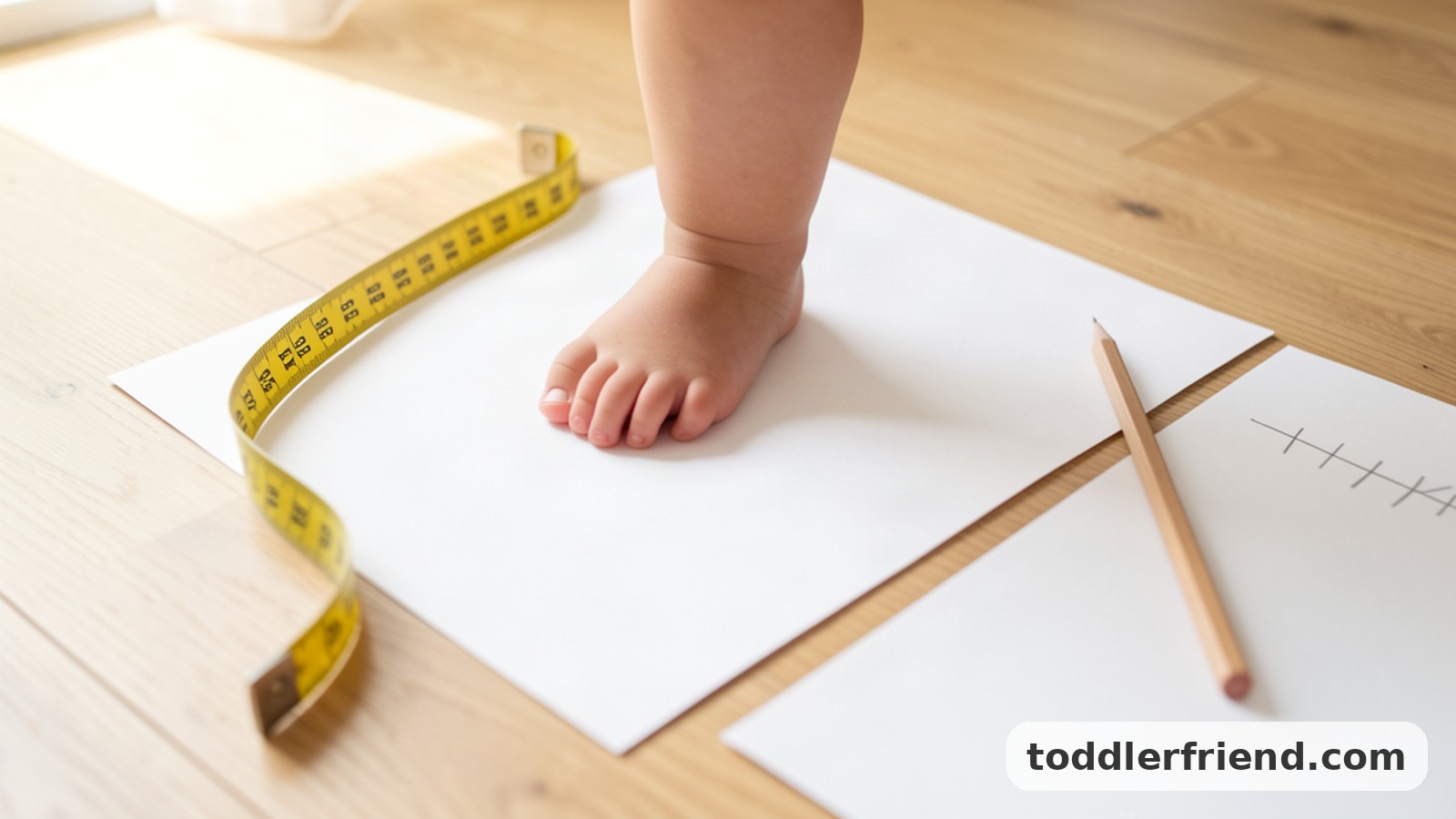
You need a sheet of paper longer than the foot, a pencil held vertically, and a ruler or soft tape marked in centimetres. Do this on a hard floor, not carpet, and do it when the child is willing to stand still for sixty seconds.
Step one: measure standing, not sitting
Weight changes the shape of a foot. Standing presses the arch down and spreads the toes, so a seated measurement comes out short. New Balance’s kids’ fit guide recommends measuring both feet while the child stands, then using the longer of the two, and Cleveland Clinic’s guidance makes the same point about standing giving a more realistic reading. Toddlers often have one foot visibly larger, and the larger foot is the one that decides the size.
Step two: mark the longest toe, which is not always the big toe
Heel against a wall or a straight edge, paper under the foot, toes flat and relaxed. Mark the tip of the longest toe, not the tip of the big toe. In many children the second toe is longer, and sizing to the big toe produces a shoe that pinches. New Balance flags this specifically in its measuring instructions.
Then measure heel mark to toe mark in centimetres and write the number down. Repeat on the other foot before you look at any chart, because the comparison is the point.
Step three: take the width across the ball of the foot
Length alone does not establish fit. Run the tape across the widest part of the forefoot, at the ball behind the toes, and record that too. John Lewis’s measuring guide describes measuring across the ball of the foot for exactly this reason, and New Balance advises measuring width as well as length. A foot can be the right length and still too wide for a narrow last, which is the fit problem a length chart will never catch.
Step four: add the growing room once, at the end
Once you have the length, the fit allowance is about half an inch, or 1.3 cm, beyond the measured foot. Treat that as room for toes to spread and for a few months of growth, not as a reason to add a whole size on top of the allowance. If two readings put you between sizes, take the larger one and check the width.
Turning the pencil mark into a size
Size charts map a foot length to a nominal size, and every brand draws that map slightly differently. The table below collects the figures we work from, each with the source that published it, so you can see how much the numbers move between charts before you commit to an order.
| Reading | Published figure | What to do with it |
|---|---|---|
| Foot length around age 2 | 13.0 cm on the Kohl’s Josmo chart; DC Shoes lists 14.0 cm | Charts disagree by a full size, so measure the child rather than the birthday |
| Foot length around age 3 | 14.6 cm on the Josmo chart, which matches a Stride Rite 7.5T entry | Use the centimetre column, not the age row |
| Foot length around age 4 | 15.6 cm on the Josmo chart; a Stride Rite 9T entry is 15.8 cm | Half a centimetre is roughly half a size here |
| Growing room beyond the foot | About 1/2 inch, or 1.3 cm | Add once, then check the heel does not lift when the child walks |
| How fast the number moves | Half a size every 2 to 4 months | Re-measure at the start of each season, not once a year |
| Arm span minus height, boys at age 2 | -1.2 cm on average | A child a centimetre short of their height is inside the reference range |
| Arm span minus height, girls at age 2 | -4.8 cm on average | Girls sit further below height at this age in the same reference data |
| Arm span to height ratio, ages 2 to 17 | 0.985 to 1.016 in boys; 0.947 to 1.003 in girls | Gerver and de Bruin reference data, 2,595 healthy children |
| Table and chair heights in our catalogue | Wooden activity play table 17.3 in; chair 20.1 in; 3 in 1 activity table set listed at 23.62 by 23.62 by 18.90 in | Compare against the child’s own seated elbow height before ordering |
The age-to-length rows are manufacturer chart entries rather than pediatric growth standards, which is why two brands can put the same two-year-old in different sizes. Every arm span figure above is a population average, and an individual child can sit outside that range and still be growing perfectly well.
Measuring wingspan without a wall chart
Stand the child against a flat wall with heels, shoulder blades and head touching it if they will cooperate, or simply have them stand tall in the middle of the room. Arms out level at shoulder height, palms forward, fingers straight. Measure from the tip of the longest finger on one hand to the tip of the longest finger on the other, straight across the back or chest at shoulder level.
Two adults make this easier: one holds the tape end at a fingertip, the other reads the far fingertip. A toddler’s arms drop within seconds, so take the reading on the first try and accept it. Write the number down beside the date and the child’s height on the same day, because the comparison is what carries information.
What the wingspan number actually tells you
In young children, arm span is typically slightly shorter than height. The Gerver and de Bruin reference data puts the average difference at about 1.2 cm below height for boys at age 2 and about 4.8 cm below for girls at age 2, with the gap closing through childhood and reversing slightly by adolescence, when average arm span runs a centimetre or two longer than height.
That means a two-year-old whose wingspan lands a few centimetres short of their height is unremarkable. What is worth writing down is the trend. If wingspan and height stay in the same relationship across two or three measurements a year apart, the child is growing along their own curve. If the relationship changes sharply, that is a question for the pediatrician rather than a search engine, and a dated record makes the conversation much shorter.
Using both numbers before you buy gear
The foot measurement decides shoes. The wingspan, plus a quick seated height check, decides whether a piece of furniture or a ride-on actually fits the child you have rather than the child on the box.
For tables, what matters is where the tabletop lands on the child. Our wooden activity play table set lists a table height of 17.3 in with a chair 20.1 in high and a 120 lb chair capacity, while the 3 in 1 wooden activity table set is listed at 23.62 by 23.62 by 18.90 in overall. A child who has to reach up to colour will slide off the chair; one whose knees hit the apron will kneel instead of sit. Our round-up of activity tables for toddlers compares those heights side by side, and the full baby and toddler furniture category lists the rest of the range.
For ride-on gear, the equivalent number is leg reach. Our baby toddler balance bike is designed for 12 to 36 months, and the ride on 3-wheel scooter carries a handle height adjustable across five positions from 26.77 to 34.65 in, with a 24.02 in deck length. A scooter whose lowest handle setting sits above a toddler’s shoulders steers badly, no matter how good the wheels are.
Five mistakes that make the numbers wrong
- Measuring a seated or lying child. Weight flattens the arch and spreads the toes, so a seated trace comes out short and the shoe comes out tight.
- Sizing to the big toe. When the second toe is longer, the big toe is the wrong landmark and the shoe ends up pinching the longest toe.
- Trusting a gauge’s printed size label. Reviews of inexpensive foot gauges are mixed, with some owners reporting labels that do not match US sizing. Read the centimetre scale and check it against the brand’s own chart.
- Buying a size up instead of checking width. A larger shoe can still be too narrow or the wrong shape, and a shoe that is too long trips a toddler who is still learning to walk.
- Measuring once a year. Half a size every two to four months adds up to two sizes between annual checks, which is why spring shoes stop fitting by autumn.
Frequently asked questions
Can I measure a toddler’s foot without a shoe gauge?
Yes. Paper, a pencil held vertically and a ruler are enough. Trace the standing foot with the heel against a straight edge, mark the longest toe, and measure in centimetres. A gauge is faster and gives a repeatable reading, but the paper method measures the same thing as long as the child is standing.
Should I add a full size for growing room?
No. The allowance is around half an inch, or 1.3 cm, beyond the measured foot length. Adding a whole size on top of that pushes the heel out of the counter and makes the shoe harder to walk in. Buy to the measurement plus the allowance, then re-measure in two to four months.
What is a typical wingspan for a two-year-old?
Expect it to land slightly below standing height. In the Gerver and de Bruin reference data, average arm span was about 1.2 cm shorter than height for two-year-old boys and about 4.8 cm shorter for two-year-old girls. Those are population averages, so a few centimetres either way is not a finding on its own.
Does wingspan always match height?
Only approximately, and the match improves with age. The reference ratio ranges from about 0.985 to 1.016 in boys and 0.947 to 1.003 in girls between the ages of 2 and 17, which is why a single reading proves little and a series of dated readings proves more.
How often should I re-measure feet and wingspan?
Feet are worth re-taking whenever you buy a closed shoe, and again mid-season while the child is in toddler sizes, because the chart pace is half a size every two to four months. Wingspan only needs re-taking on the days you record height, so the two numbers stay comparable across the year.
Do it once, then keep the sheet
Ten minutes with paper, a pencil and a soft tape gives you the two numbers that most buying decisions actually depend on. Trace the standing foot to its longest toe, take the width across the ball, allow the half inch of growing room, and note the arm span on the same page as the height. Date it, stick it inside a cupboard door, and re-take it when the seasons change.
If you would rather not trace, a home sizer speeds the job up. The Squatchi shoe sizer covers sizes 2T to 6Y, measures 11.7 by 5.5 by 1 in overall, and weighs 5.28 oz, so it stores in a drawer. Note what owners report: it reads length but not width, so keep the tape for the ball of the foot. A foot measuring gauge with a centimetre scale does the same job for a few dollars, and the centimetre reading is the part that matters when you compare against a brand chart.
