

Guide
Wooden vs Plastic Play Kitchens: Which Is Better for Kids
Nov
Wooden vs Plastic Play Kitchens: Which Is Better for Kids
Are wooden or plastic play kitchens better for kids? Neither material is better by itself: the kitchen your child can reach, cannot tip, and can be wiped clean wins, and both materials deliver that when the model is built for a toddler’s height.
The question sounds like a materials argument, but in practice it is a fit problem. A play kitchen is furniture your toddler stands inside of. They lean their weight on the counter, hang on the oven door, and test the shelves with a foot. Wood and plastic change the weight of the unit, the assembly, and how the surface survives a spilled drink. They do not change whether the counter sits at your child’s chest or above their head.
What follows is built from the published figures on five listings, the three points where the materials genuinely diverge, and a check you can run in a store aisle in about five minutes. Anything tied to one model is labelled that way rather than generalised.
What a finish certificate and an age label actually cover(citations verified 2026-10-18)
Material debates turn into safety claims quickly, so it helps to know which rules exist and what they cover on a painted or coated play kitchen sold in the United States. Two of them do most of the work for a toddler.
- What is in the coating: 16 CFR Part 1303. This is the lead limit for paint and surface coatings, and it applies to painted wood and to decorated plastic parts alike. Ask the seller for the compliance statement instead of judging safety from a colour swatch.
- What a small child can swallow: 16 CFR Part 1501. The small-parts rule is about the cups, lids, pretend food and knobs. Those are the same whether the kitchen body is wood or moulded plastic, so the material label tells you nothing here.
Neither rule sets a child-load limit, so no certificate on the carton means a wooden kitchen may be climbed on. Only the manufacturer’s own instructions can tell you that.
Reference only, not legal advice. These are manufacturer and seller duties; the eCFR pages linked above are the authority.
The verdict, stated plainly
Plastic is the easier kitchen to live with. It arrives in fewer pieces, wipes down without a second thought, and costs less for the same footprint. Wood is the kitchen that behaves like furniture: heavier, quieter when a child leans on it, and worth repairing rather than replacing. Both statements are true of well-made examples and false of badly made ones.
The variable that decides most purchases is not the material at all. It is whether the unit will stay where you put it. A 22 lb plastic kitchen on a wide base, strapped to the wall, can be steadier in use than a tall wooden one with a narrow footprint and a loose cam lock. If you are weighing a specific model rather than a category, start with our play kitchen guide for two-year-olds, which works through counter height and reach for the youngest users.
What the published figures actually show
Five listings, read the same way, give a fair picture of the range sold for toddlers. The columns matter more than the individual models: footprint, counter height, unit weight and any stated load limit. Most listings publish the first three and skip the last one entirely.
| Model (as listed) | Material stated | Size or counter height | Unit weight | Stated child-load limit |
|---|---|---|---|---|
| Step2 Best Chefs kitchen | Moulded plastic, double-walled | 35.8 H x 34.4 W x 11.5 D in | 22.5 lb | None published |
| Step2 Modern Cook kitchen | Moulded plastic | Counter about 21 in | Not published | 60 lb, per the listing |
| Qaba wooden play kitchen | MDF, pine wood and PP | Not given in the listing excerpt | Not published | 110 lb tabletop capacity |
| Wooden example at the large end of the range | Wood or engineered wood | 43.2 x 15.5 x 39.0 in | 30 to 65 lb across wooden examples | None published |
| Compact plastic example | Plastic | 20.9 x 8.7 x 27.2 in | Not published | None published |
Two things stand out. On the listings compared here, the wooden kitchens publish unit weights of 30 to 65 lb, while the plastic kitchens publish 22 to 24 lb. A stated load limit is rare enough that its presence tells you something: the Qaba listing rates its tabletop at 110 lb, and the Step2 Modern Cook rates the whole unit at 60 lb. Neither figure transfers to a different model from the same brand.
Counter height travels in a narrower band than you might expect. Across the comparison set it sits between about 19 and 24 in off the floor, with some listings at 18 to 19 in and one at roughly 21 in. That is the number to hold against your child, not the overall height of the toy.
Where the materials really diverge
Assembly, and the wobble that appears in month three
A wooden kitchen arrives as a flat pack: panels, cam locks, a bag of screws and an instruction sheet with more steps than most parents expect. The recurring owner complaint is not the time it takes but what happens when one fastener is missed or works loose, because a single loose cam can leave a whole side panel moving. Plastic kitchens are usually fewer, larger mouldings that click or bolt together in a short session, and there is less to get wrong.
If you choose wood, budget an evening and then re-check every fixing after the first week of play. A wobble you can feel with one hand on the counter is the thing to fix before a child leans on it. Our notes on the wooden kitchen playsets we have reviewed cover the models where this comes up.
Moisture, finishes and wiping down
Plastic has one obvious advantage and it is not strength: a spill is a wipe. Moulded surfaces do not care about a puddle of water on the counter, and there are no seams for liquid to sit in. Wood-based kitchens are often MDF or plywood with a painted or laminated skin, and those panels are the part that suffers when water reaches an exposed edge or a screw hole. A laminate counter is fine; an unsealed particleboard edge under a sink is not.
The finish is also the part of a kitchen that safety rules actually address. Under 16 CFR 1250.2, a toy sold in the US must meet ASTM F963. The CPSC describes that standard as addressing hazards including material quality, toxicology, edges, fasteners, stability and overload requirements. Hape states that its wooden Cook and Serve kitchen meets EN 71 and ASTM F963; that is a manufacturer claim for a specific model, not a property of wood as a material. Ask the same question of any brand you are considering and expect a document rather than a badge.
Weight, tipping and the climbing problem
Light is not automatically unstable, but light and tall is a bad combination. A plastic kitchen that a child can drag across the floor is also one they can pull over, which is why the wall attachment in the box is not optional for a two-year-old. Heavier wooden units resist that push better by sheer mass, but mass is not a guarantee either: a tall unit with a shallow footprint still tips.
None of them is a climbing frame. Buying guides reviewed for this piece recommend using the wall attachment that ships with light or tall units, and a two-year-old will test that advice within a week. Anchor the kitchen to the wall, keep the counter clear of anything that looks like a foothold, and put a toddler tower at the real counter if what your child wants is to cook at adult height.
A five-minute check before you pay
- Counter against your child. Have them stand flat-footed next to it. A worktop around 19 to 24 in should land near waist or lower chest height; above that, they will reach up and eventually climb.
- Footprint against the wall. Most freestanding kitchens run 30 to 45 in wide and 11 to 16 in deep. Add standing room in front and clearance for doors to swing.
- The doors. Open and close the oven and fridge. A downward-opening oven door takes weight on its hinge; check whether that hinge is pinned or just a plastic tab.
- The loose pieces. Count the cups, lids and pretend food. For a child still mouthing toys, fewer and larger beats a bigger accessory set.
- The anchor. If there is no strap or bracket in the box, plan to buy one.
- The wipe test. Run a wet thumb along the counter edge. If it is raw board, water will find it.
Age labels are worth reading on their own terms, because a kitchen sold for three and up is a different product from one sold for two and up. Our guide to what age a kitchen playset suits explains why the gap matters more than the toy itself.
One model from each side of the question
The wooden Melissa & Doug Wooden Chef’s kitchen is the clearest illustration of the furniture argument: a full-height cabinet unit with an oven, microwave, sink, a refrigerator with a working ice dispenser, and doors that open and close, sold for ages three and up and described by the brand as sturdy wooden construction. Its own instruction sheet is the place to confirm assembly and anchoring, because the brand does not publish a child-load limit. See the Melissa and Doug Wooden Chef’s kitchen on Amazon.
The plastic side is the Step2 Best Chefs kitchen on Amazon. It is a moulded double-walled unit with an open design, lights and sounds on the hob, doors on the oven and fridge, a pass-through window, and a large accessory set that includes pots, pans and utensils. It weighs 22.5 lb on a 34.4 in wide base, which is the combination that makes a plastic kitchen feel planted rather than skittish.
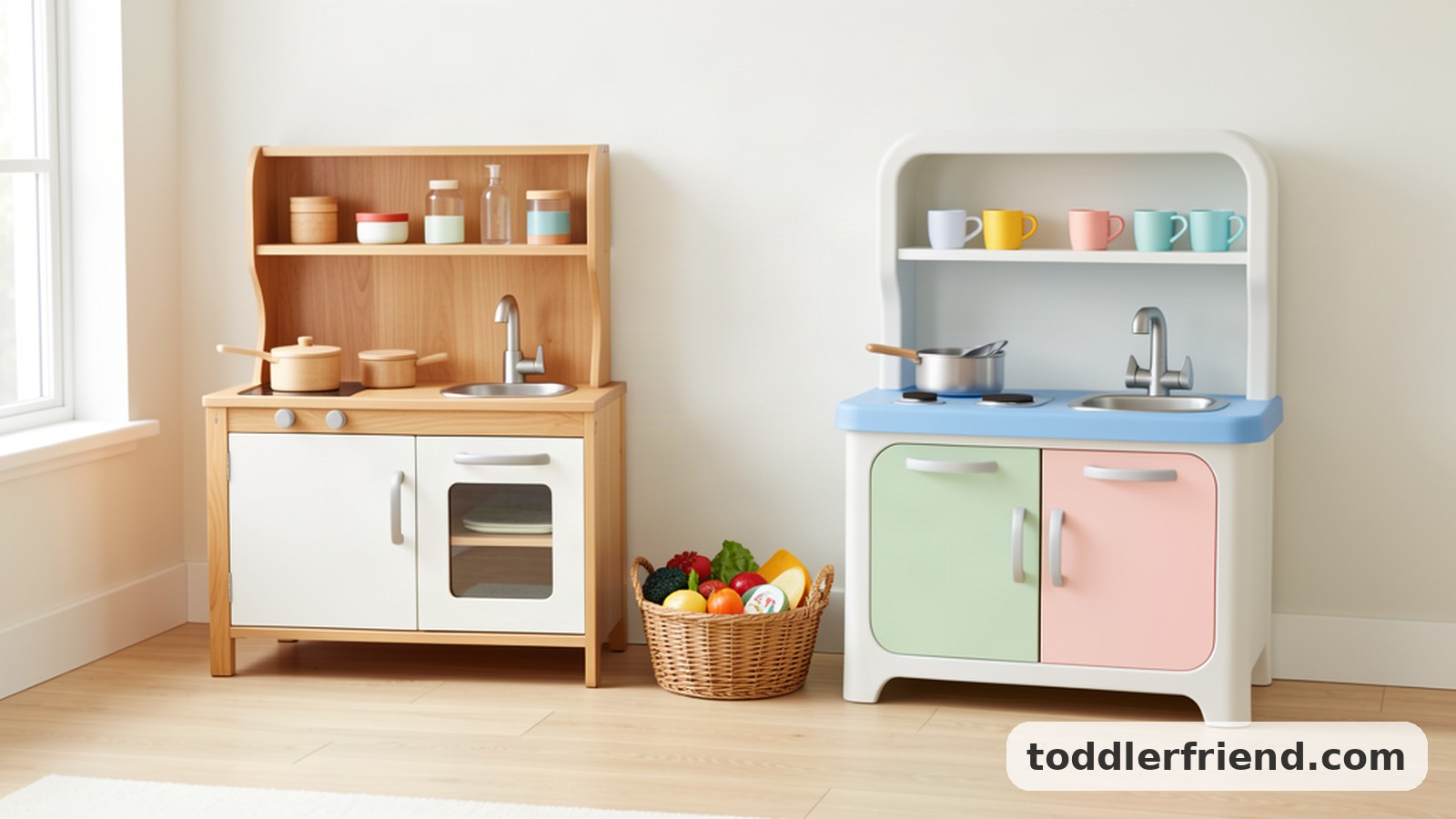
Set side by side, they are the same purchase made for different reasons. The wood model is bought for permanence and looks; the plastic one is bought for a small room, a quick setup, and a surface that survives yogurt. Neither listing promises your child can stand on it.
Play value, for what it is worth, is not divided by material. A kitchen earns its floor space through the pretend cooking, the ordering and the turn-taking it invites, which is the same argument we make in the developmental case for kitchen playsets. If you are comparing wooden kitchens specifically, our piece on what a wooden playset adds goes further, and our activity toys category covers the smaller pieces that end up around it.
Frequently Asked Questions
Are wooden play kitchens better than plastic ones?
Not as a category. On the listings compared here, wooden kitchens publish unit weights of 30 to 65 lb against about 22 to 24 lb for plastic, and that mass helps them stay put when a child leans on the counter. Plastic kitchens are easier to clean and faster to assemble. Whether either is better depends on the counter height, footprint and anchoring of the specific model.
Is plastic safe for a toddler to chew on?
The material label is the wrong thing to check. What matters is whether the parts a child mouths are small enough to be a choking hazard under 16 CFR 1501, and whether the coating meets the lead limit in 16 CFR 1303. Both questions are answered by the seller’s compliance documentation, not by wood versus plastic.
Do wooden play kitchens tip over more easily?
Less easily than light plastic ones, if the footprint is comparable, because the unit weighs more. A tall wooden kitchen with a shallow base can still tip, which is why the wall attachment in the box is worth fitting whatever the material.
How much floor space does a play kitchen need?
Most freestanding kitchens in the comparison set run 30 to 45 in wide and 11 to 16 in deep, and compact plastic models go as small as 20.9 x 8.7 x 27.2 in. Add space in front for a child to stand and room for the doors to open before you commit to a corner.
Can my child stand or climb on a play kitchen?
No, unless the manufacturer’s own instructions say the unit is designed for it. The load figures in the comparison set are surface or unit ratings, and none of the listings we read says the kitchen may be stood on. The counter at adult height is what a toddler tower is for.
