

Guide
Bounce House Ball Pit: Safety, Sizing and Setup Guide
Oct
Bounce House Ball Pit: Safety, Sizing and Setup Guide
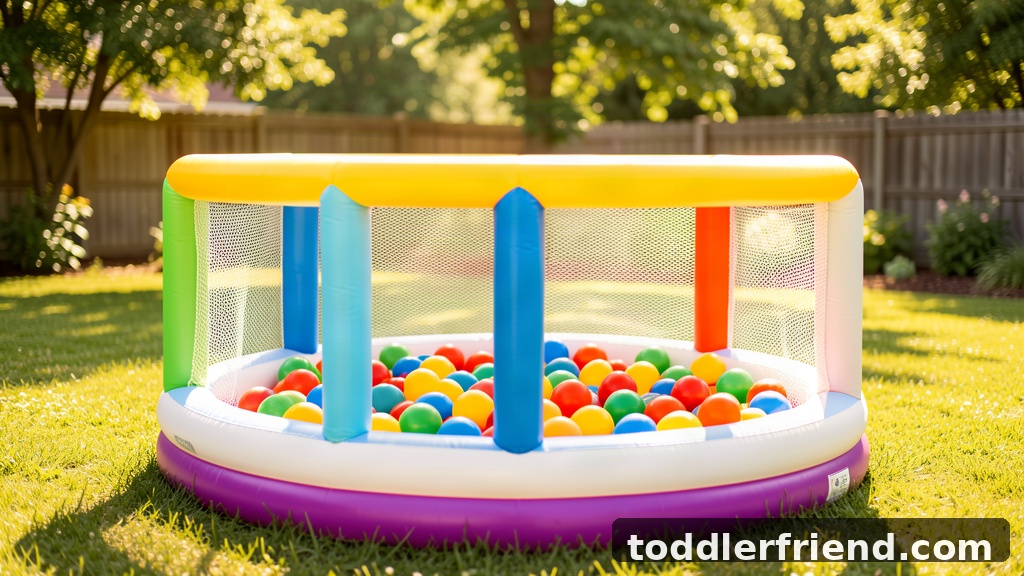
Definition: A bounce house ball pit is an inflatable play structure that pairs a low, netted jumping chamber with an attached ball-pit basin inside one footprint. It is sold by its inflated dimensions, limited by a per-child and a total weight rating, and built from coated Oxford polyester or PVC fabric.
The appeal is obvious: one purchase gives a toddler somewhere to jump, roll and dig, indoors on a rainy afternoon or out on the lawn. The trouble starts at checkout, because the numbers on the box describe an inflated shell, not the space your floor actually gives it or the weight your child actually puts on the jump surface. Two families can buy the same listing and end up with one unit that fits a playroom and one that has to live in the garage.
This guide works from published specifications and the standards that cover inflatable play equipment. You will get the measurement routine, the difference between a per-child and a total weight limit, what the fabric grades mean, and the setup checks that keep a toddler safe once the blower is running.
What a bounce house ball pit actually contains
Almost every unit in this category is a constant-air inflatable: a blower runs the whole time the structure is up, pushing air through stitched seams to hold the walls and jump floor firm. That design is why the bouncer deflates the moment the blower stops, and why the power cord is part of the safety picture rather than an afterthought. It also means the mesh walls you see in photos are load-bearing only in the sense that they keep a child inside the play area.
The two zones are sized separately, and listings usually publish both. The jump chamber is the smaller figure, roughly five feet across on most home units, while the ball-pit basin is a shallow tray at one end. On one Qaba castle the pool measures 65 by 49.2 in with a depth of just under eight inches, which tells you the pit is a sitting-and-scooping area, not a deep well.
Here is how the published figures compare across five representative units. Read it as a spread of what the category offers, not as a ranking.
| Unit (as listed) | Inflated overall size | Jump area | Ball pit | Weight rating |
|---|---|---|---|---|
| Costway 6-in-1 | 116.5 x 113 x 72 in | 57.5 x 58.5 in | 51.5 x 27 in | 100 lb per child; 200 lb total |
| Costway with slide | 116 x 114 x 75 in | 59 x 56 in | 55 x 27 in | 100 lb per child; 200 lb total |
| KRISRATE castle | 169 x 82 x 63 in | 65 x 62 in | Not stated in listing | 300 lb total |
| Gymax play centre | 12.5 x 11.5 x 7.5 ft | 57.1 x 58.3 in | Not stated in listing | 300 lb total |
| Qaba white castle | 98.4 x 88.6 x 78.7 in | Not stated in listing | 65 x 49.2 x 7.9 in | 60 lb maximum |
Quotable: In the five units above, the jump chamber clusters around 57 to 65 in on each side while overall footprints run from roughly eight feet to more than fourteen feet long, so the outside size is a poor guide to how much jumping room a toddler gets.
Sizing: measure the room before you read the reviews
Start with the inflated length and width, then add clearance on every side. You need room to walk around the unit, room for the blower tube at one end, and room for a child to fall out of the doorway without meeting a coffee table. A 116 in unit is nearly ten feet of floor, which rules out most apartments and many playrooms once furniture is in place.
Indoors, ceiling height matters too; some castles run to 78 in or more at the peaks, and a ceiling fan or pendant light sits lower than the ceiling itself. Outdoors, the surface decides more than the size: grass is soft but uneven under a flat inflatable floor, and pavement is flat but unforgiving. Most manuals ask for a level, clear area with nothing sharp or hot nearby.
The last number people forget is ball count. A pit that arrives with thirty to fifty balls looks sparse the moment a toddler sits in it. Buying guides aimed at home pits suggest a few hundred balls to fill one properly, so treat the included bag as a starter and budget for a top-up.
Per-child and total weight limits are different promises
A rating that reads “100 lb per child, 200 lb total” tells you two things at once: no single child over 100 lb, and no combination over 200 lb. A thirty-pound toddler is nowhere near the per-child figure, but three cousins at forty pounds each are already past half the total. Read both numbers and plan for the smallest one to bind first.
Units marketed to toddlers sometimes carry a much lower ceiling. The Qaba castle in the table is rated to 60 lb maximum in total, which is fine for one small child and not fine for a pair of older siblings. Where a listing gives only one figure, assume it is the total and act accordingly.
Age labels deserve the same suspicion. Compact units bounce best for light children; one parent review of a Little Tikes bouncer reported that a five-year-old weighing 46 lb could barely get any lift while a three-year-old bounced easily. If your household spans a toddler and a school-age child, expect the older one to be underwhelmed by a toddler-sized floor.
Fabric, seams and the standards behind them
Home units are typically built from woven polyester Oxford cloth in 420D or 600D, often with a PVC coating on the inside face. The denier number describes yarn thickness, not strength on its own; seam construction, coating and reinforcement at the anchor points decide whether the shell survives a season. Commercial inflatables step up to heavier PVC tarpaulin in the region of 18 oz, with webbing reinforcement and multiple rows of stitching.
The European standard for inflatable play equipment, EN 14960-1, addresses exactly these points: fabric and seam tear and tensile strength for the intended user weight, plus non-rotting thread with at least 88 N tensile strength and lock-stitching. In the United States, ASTM F2374 covers the design, manufacture, operation and maintenance of inflatable amusement devices. Neither is a consumer guarantee printed on a toy carton, but both tell you what a well-built unit should be able to show.
The Consumer Product Safety Commission publishes guidance on constant air inflatable play devices that is worth reading before you buy, particularly on anchoring and supervision.
Quotable: EN 14960-1 requires inflatable play equipment to use non-rotting thread of at least 88 N tensile strength and lock-stitching, a concrete benchmark you can ask a seller about when a listing only says “heavy duty”.
Setting up a ball pit bouncer for a toddler
The setup sequence matters more than the feature list. Work through these steps in order, because each one changes what the next one looks like.
- Clear and level the site. Remove stones, sticks, toys and anything with an edge, and pick a surface the manual allows. Indoors, move furniture well beyond the inflated footprint so a child exiting the doorway lands on open floor.
- Inflate, then measure again. Blowers vary; a unit listed at 116 in can sit differently once the seams are tight. Mark the real footprint with painter’s tape and check the walkway you planned still exists.
- Anchor it the way the manual says. Most home units ship with stakes for grass or sandbags for hard surfaces. An unanchored constant-air bouncer can shift or lift in a gust, and the CPSC guidance treats anchoring as part of normal use rather than an optional extra.
- Route the cord out of reach. Use a grounded outlet with a residual-current or GFCI device, keep the cord away from the entry, and never run the blower through a puddle. The blower intake also needs to stay clear of balls, blankets and small hands.
- Check the balls against your child’s age. Balls small enough to pass a choke-test cylinder are a hazard for children under three, who still mouth objects. For a two-year-old, choose larger balls or supervise the pit closely and remove crushed or split ones.
- Set the house rules before the first jump. Shoes off, no food or drinks inside, one child in the jump chamber at a time for toddlers, and an adult within arm’s reach for the whole session. Empty the pit and dry the shell fully before storage, because trapped moisture is what turns a fabric unit into a mouldy one.
What buyers most often get wrong
The recurring complaint in owner reviews is not quality but mismatch. Units arrive smaller than the photos implied, or the bounce feels flat for a heavier child, or the pit needs far more balls than were supplied. None of those are defects; all of them are things the listing could have told you and did not.
A second cluster of problems comes from treating the inflatable as permanent furniture. Constant-air units are not meant to stay up for days on end, and UV exposure, grit in the seams and a blower running unattended all shorten their life. Inflate for the session, deflate after, and store it dry.
If your child is under two and still unsteady on their feet, a soft foam playset or a low foam climbing set is usually the better first step; the inflatable can wait until they can climb in and out of a doorway without help. Our guide to soft climb and crawl foam playsets covers that stage.

Which type fits a toddler household
For a single toddler in a small space, a compact three-in-one unit with a low jump floor and a small basin is the sensible pick. The QPAU three-in-one bounce house for toddlers is built for the one-to-three age band with a ball pit and a small trampoline area, which suits a child who is still learning to jump. For a family with a three- and a five-year-old, a larger castle with a slide is more useful; the VOSSER three-in-one inflatable with ball pit is rated for ages one to six and uses mesh walls, which helps when two children share the chamber.
Our own shop carries a seven-in-one inflatable bounce house in the same family, and the full inflatable bouncers collection is the place to compare footprints side by side. If you are still deciding whether an inflatable belongs in your yard at all, the wider outdoor play equipment range covers swings, climbers and trampolines that need no blower, and our guide to outdoor toddler trampolines explains what changes when the bouncing surface is sprung rather than inflated.

Frequently asked questions
How many balls do I need for a bounce house ball pit?
Most home pits are filled with a few hundred balls; buying guidance for kids ball pits suggests roughly 200 to 500, depending on the basin size. Packages commonly include only 30 to 50, so plan to buy more. A pit with fewer balls is still usable, it just will not cushion a toddler sitting down.
Can a two-year-old use a bounce house ball pit?
Yes, with conditions. Choose a unit whose age label includes two, keep the session to one child at a time, stay within arm’s reach, and check the balls against the choke-test rule for under-threes. Compact toddler units with low jump floors suit this age better than full-size castles.
What does a 100 lb per child and 200 lb total rating mean?
It sets two separate ceilings. No single child may weigh more than 100 lb, and everyone inside together may not exceed 200 lb. For toddlers the per-child figure is rarely the constraint; the total is what limits how many children can play at once.
How long can a constant-air bounce house stay inflated?
The blower has to run the whole time the unit is up, so it stays inflated for as long as the session lasts and deflates when the power stops. Manufacturers generally expect session use rather than permanent installation, and long UV exposure plus grit in the seams wears the fabric faster.
Do bounce houses need to be anchored?
Yes. Home units ship with stakes for grass or sandbags for hard surfaces, and the anchoring instructions are part of normal use, not an accessory. An unanchored constant-air inflatable can shift or lift in wind, and the CPSC guidance on these devices treats anchoring and supervision as core requirements.
The short version
Buy by footprint and weight rating, not by the photo. Measure the space you have, add clearance for the blower and the doorway, read both weight numbers, ask what fabric and thread the seams use, then anchor the unit and supervise every session. Do those five things and a bounce house ball pit becomes a genuinely useful piece of toddler gear rather than a large object that lives in the garage.
Compare the models in our inflatable bouncers collection first, and read our outdoor play equipment guide if you are still choosing between an inflatable, a swing set and a climber.
