

Guide
Play Kitchen for 2 Year Olds: Sizing, Safety, and Picks
Oct
Play Kitchen for 2 Year Olds: Sizing, Safety, and Picks
Definition: A play kitchen for 2-year-olds is a floor-standing pretend-cooking set sized so a standing toddler can reach the hob, sink and worktop. The models we checked run roughly 34 to 36 in wide, 11 to 13 in deep and 36 to 41 in tall, with worktops close to 21 in off the floor.
Most play kitchens are sold to a wide age band, and that is where two-year-olds get lost. A set marketed for ages 3 and up can still look perfect in the product photo, then arrive with a worktop above your child’s shoulders or a box of accessories small enough to disappear into a mouth. The kitchen you want is the one your two-year-old can stand at, reach into, and pull on without the whole thing coming over.
This guide sticks to what you can measure and check before you buy: the counter height against your child, the footprint against your floor, the age label against how your child still mouths toys, and the assembly and anchoring work that decides whether the unit stays upright in month three.
Two federal rules that decide whether a toy kitchen suits a two-year-old
Age bands on the box are marketing. Two federal rules do the real work for a child this age: the small-parts rule, which is about the size of the accessories, and the lead-in-paint limit, which is about what is on the surface.
| What it covers | Citation | Source |
|---|---|---|
| Small parts, toys for children under 3 | 16 CFR Part 1501 | official text |
| Lead in paint and surface coatings | 16 CFR Part 1303 | official text |
What this means at the shelf
- For a child under three, the small-parts rule in 16 CFR 1501 is the one that matters: cups, lids, pretend food and knobs that fit inside the choke tube are the hazard, not the age printed on the carton.
- Finish limits come from 16 CFR 1303. Ask the seller for the compliance statement on painted parts instead of judging a colour swatch in a listing photo.
- Neither rule tells you the kitchen can take your child’s weight. No federal standard sets a child-load limit for a toy kitchen.
Reference only, not legal advice. These are manufacturer and seller duties; read the current eCFR text before relying on it.
What size play kitchen actually fits a two-year-old
The published dimensions are the only hard numbers you get before delivery, and they nearly all describe the outside of the box, not the part your child touches. The table below collects the figures from manufacturer and retailer listings for four Step2 kitchens and one mixed-material model, all of which appear in 2-plus or family age ranges.
| Model (as listed) | Assembled size, H x W x D | Product weight | Published load limit |
|---|---|---|---|
| Step2 Best Chefs | 35.8 x 34.4 x 11.5 in | 22.5 lb | None published |
| Step2 Cooking Time | 39.5 x 33.5 x 12.5 in | Not stated in the listing | None published |
| Step2 Love to Entertain | 38.5 x 34.5 x 11.75 in | Not stated in the listing | None published; counter about 21 in |
| Step2 Fun with Friends | 40.88 x 35.75 x 12.5 in | About 22 to 24.25 lb, by listing | None published |
| Step2 Harmony (engineered wood and resin) | 33.75 x 39.75 x 13 in | Not stated in the listing | None published |
Read the table as a footprint, not a fit guarantee. Every body in it is a little under three feet wide and about a foot deep, so plan on a three-foot stretch of wall plus an arm’s length of open floor in front of it. Height matters less than it looks, because the overall figure usually includes a back panel, shelf or hood above the actual play surface.
Quotable: none of the Step2 kitchens in this comparison publishes a child-weight or countertop load limit, so the honest instruction is to treat the unit as a floor-standing toy and not as a seat, a step or a climbing frame.
Counter height is the number to hold against your child
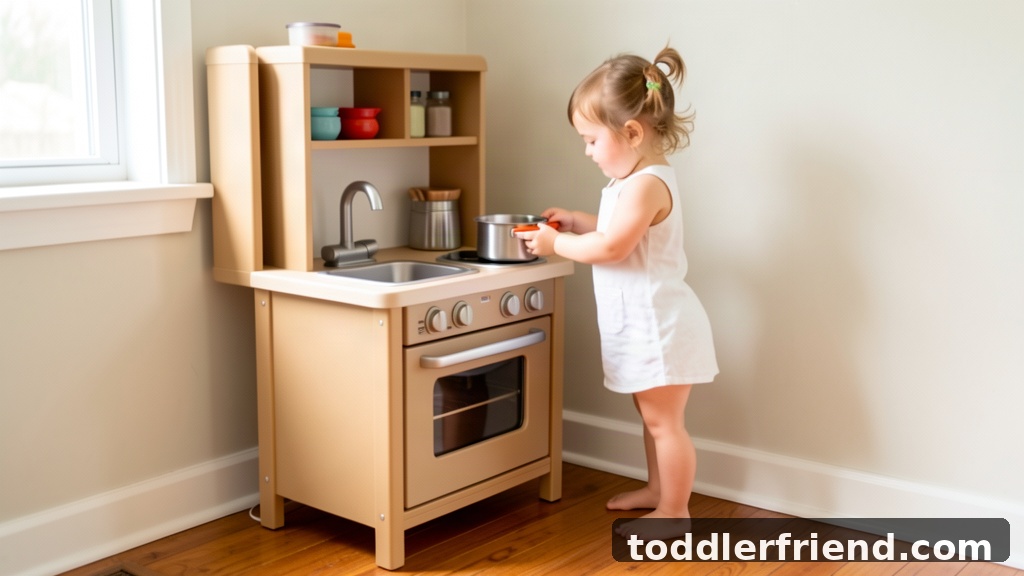
One listing in the set gives a usable interior figure: the Step2 Love to Entertain has a worktop about 21 in from the floor. That is the dimension to test at home before ordering, not the 38 in overall height. Put a tape measure on the kitchen bench or table your two-year-old already uses and see where their elbows land.
A worktop that sits at or a little below chest height lets a toddler stand flat-footed and reach the hob, which is the whole point of the toy. A worktop above the shoulder line invites the two compensations you do not want: tiptoeing on the base, or pulling the unit toward the body to reach over the front edge. If your child is at the small end of the two-year range, a 33 to 34 in model with a lower worktop beats a taller one with more features.
Plastic, wood, or mixed materials
Material tells you about weight, edges and repair, not about safety on its own. Molded plastic and resin dominate toddler kitchens because they have no splinters, no exposed fasteners on the play face and a wipe-clean surface; strength still depends on wall thickness, moulding and how the panels lock together. Engineered wood and solid wood give rigid panels and a heavier footprint, and the strength depends on panel thickness and the fasteners rather than the material name.
Mixed builds are increasingly common: the Step2 Harmony combines engineered wood elements with resin in a 33.75 x 39.75 x 13 in body. Read that as a hybrid, and check both halves in the manual, because the wood panels carry the anchoring instructions and the resin carries the molded accessories. If the wood-versus-plastic question is really about which survives a toddler, the wider comparison in our guide to wood and plastic toddler tables applies to play kitchens too.
Small parts, mouthing, and the age label
Many play kitchens are labelled 3-plus, and the label is not arbitrary: the accessory sets often include pieces that a child who still mouths objects should not have unsupervised. A 2-in-1 set we checked states a 66 lb capacity for its table but is listed for ages 3 to 8, which makes it a poor match for a two-year-old regardless of how sturdy the table is. The capacity figure is also a table load claim, not a rating for a child climbing on the unit.
There is a floor under all of this. Under 16 CFR 1250.2, a toy kitchen sold in the United States must comply with the applicable provisions of ASTM F963-23, the general toy safety standard. That framework covers the toy as a toy: it does not turn the unit into furniture, and it sets no child-load limit for leaning, sitting or climbing.
Practical rule: buy the kitchen for the child, then edit the accessory box. Cups, lids, play food and coffee pods that fit inside a choke-test cylinder go into a lidded bin until the mouthing phase ends, and the kitchen stays out with the larger pots and pans. Keep the pieces you removed in the same box as the manual, so the set can go back together when the child is ready for it.
Five set-up problems owners keep reporting
Assembly and placement cause more disappointment than design does. These are the recurring reports in owner reviews and testing write-ups, and each one is cheap to plan for before the box arrives.
- Assembly time varies wildly. Best Products reported that the Lalo kitchen it tested went together in about three minutes, while other models take hours; Step2 owners specifically mention hard-to-start screws and panels without pre-drilled holes. Check the parts and hardware before you start, and budget a second adult.
- Door and play clearance gets ignored. Measure width and depth, then add room for cabinet doors, the oven door and a child standing in front. A kitchen wedged into a corner loses half its play value.
- Toddlers pull and climb even on units adults call unclimbable. Tall or top-heavy kitchens can tip. Use the supplied wall anchor where the manual asks for one, and supervise pulling on open doors.
- Downward-opening oven doors take load. One owner discussion describes an oven door that was stood on and broke. Check how the door is hinged and whether the hinge takes weight on the panel edge or on a proper hinge pin.
- Feature lists outrun usefulness. Small ice-maker openings that will not fit a child’s cup, and knobs too stiff for toddler hands, add cost without adding play. Try the moving parts in the shop if you can.
Two kitchens that carry a 2-plus age label
The Step2 Best Chefs kitchen is the safest starting point for this age group: it is sold for toddlers 2 and up, comes with a 25-piece accessory set, and its 35.8 x 34.4 x 11.5 in body weighs 22.5 lb, which is heavy enough to feel planted without needing two adults to move it. Check the current Step2 Best Chefs kitchen listing on Amazon.
The Step2 Fun with Friends kitchen is the wider option, at 40.88 x 35.75 x 12.5 in and roughly 22 to 24.25 lb depending on the listing, also labelled 2-plus, with lights and sounds. It needs about four feet of wall and is the better pick if two children will cook side by side. See the Step2 Fun with Friends kitchen on Amazon.
Neither listing publishes a load limit, and neither should be used as a step. If you want the kitchen at bench height for a standing child, the safer route is a toddler kitchen helper tower used at the real counter, not a play kitchen climbed on.
Frequently asked questions
Is a play kitchen suitable for a 2-year-old?
Yes, provided the model carries a 2-plus label and you remove small accessories. Two-year-olds are at the pull-and-mouth stage, so the risks are tipping and choking pieces rather than the pretend cooking itself. Check the counter height against your child and anchor the unit if the manual asks for it.
How tall should a play kitchen be for a toddler?
Aim for a worktop a toddler can reach standing flat-footed, which in the models we checked means a counter around 21 in from the floor inside a body roughly 36 to 41 in tall. Measure your child’s chest height and compare that with the worktop, not with the overall height on the box.
How much floor space does a play kitchen need?
Plan on about three feet of wall for the unit itself, since the bodies we checked run 34 to 36 in wide and 11 to 13 in deep, plus arm’s length of open floor in front for the child and the doors. Corner placement needs extra clearance for cabinet doors that swing outward.
Are wooden play kitchens safer than plastic ones?
Neither material is safer by itself. Wood panels need checking for splinters, fastener security and anchoring, while plastic and resin need checking for moulding quality and stiff knobs. The rules that decide safety are about small parts and surface coatings, not the material name.
Do I need to anchor a play kitchen to the wall?
Follow the manual. If the manufacturer supplies a wall anchor or strap, fit it: toddlers pull on open doors and shelves, and a tall or top-heavy unit can tip. Where no anchor is supplied, keep the kitchen against a wall and out of the path children run through.
What to do before you buy
Measure the wall, measure the child, then read the age label as a warning rather than a formality. Shortlist two models, check that each one’s worktop suits your toddler, and confirm the accessory count you are taking on. Our activity table shortlist for toddlers and the wider activity toys collection cover the furniture that pairs with a kitchen corner, and the play table sets work well as the prep surface next to it. If you are building out the pretend-play corner rather than just the cooking station, our market stall toy guide covers the shop-side alternatives.
